











Sikorsky is moving rapidly to mature its new family of autonomous rotorcraft, to include testing a full-scale demonstrator.
The vertical-lift manufacturer on 6 October revealed a new trade name for its burgeoning family of uncrewed rotor-blown wing vehicles, which now includes a full-scale test demonstrator.
Previously known only as its rotor-blown wing (RBW) programme, the new class of uncrewed tail-sitters will now be called Nomad.
“The focus here is on the ability of this vertical take-off and landing [VTOL] UAS [uncrewed aerial system] to operate in austere environments from shipboard operations and runway independent places,” says Ramsey Bentley, director of strategy and business development for Sikorsky advanced programmes.
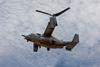
With a hybrid-electric propulsion system, the Nomad has twin wing-mounted prop-rotors that generate lift by blowing air over a central wing. Once airborne, the craft rotates 90°, transitioning from vertical to horizontal flight.
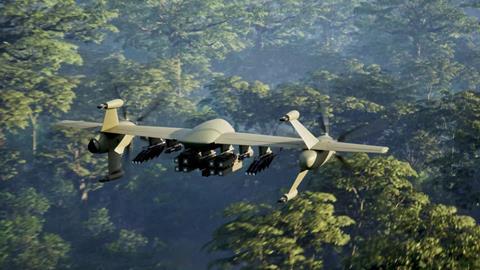
Autonomous flight is enabled by Sikorsky’s Matrix technology, which the company had developed to enable uncrewed and reduced-pilot operations of conventional rotorcraft like UH-60 Black Hawks.
Sikorsky is continuing its previously outlined concept of offering multiple-sized Nomad variants, including options in the large Group 3 and Group 4 categories of UAS.
Group 3 UAS are generally defined by the Pentagon as having a maximum gross take-off weight of less than 600kg (1,320lb) and operating below 18,000ft, with airspeed less than 250kt (463km/h). The larger Group 4 category includes UAS weighing more than 600kg and capable of flying at any airspeed but that still operate below 18,000ft.
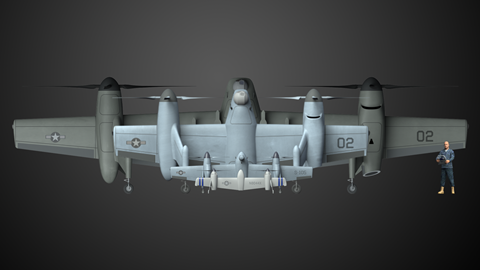
Sikorsky general manager Rich Benton says the company envisions the largest Nomad variant will occupy a roughly similar footprint as one of the company’s widely-fielded Black Hawk utility helicopters.
“The resulting Nomad family of drones will be adaptable, go-anywhere, runway-independent aircraft capable of land- and sea-based missions across defence, national security, forestry and civilian organisations,” Benton says.
The company has been flying a smaller, subscale RBW demonstrator called the Nomad 50 for much of the past year. That vehicle has a 3.1m (10ft 1in) wingspan, weighs 52kg and has a 9kg payload.
But Sikorsky is focused on its Group 3 rotor-blown wing design, dubbed Nomad 100. That vehicle, with a 5.4m wingspan, is being ground tested. A first flight and aerial test campaign are expected in the coming months, Sikorsky says.
Eyeing potential new business with the US Army, Sikorsky is positioning the Nomad 100 to take over reconnaissance missions carried out by Textron’s RQ-7B Shadow, which is being phased out under a sweeping aviation transformation initiative.
A design for a Group 4 Nomad intended to replace General Atomics Aeronautical Systems’ MQ-1C Gray Eagle reconnaissance aircraft has also been developed and is being discussed with customers, with Sikorsky mulling options for building a demonstrator vehicle in that class. It has not given its Group 4 Nomad a formal designation.
“The Group 3- and the Group 4-sized aircraft can do both kinetic and non-kinetic effects missions,” Bentley notes. “They also have a cargo capability for contested logistics.”
Sikorsky is also competing the Nomad 100 in a technology maturation programme with the US Defense Advanced Research Projects Agency (DARPA) called Early VTOL Aircraft Demonstration, or EVADE.
That effort evolved from an earlier DARPA programme called ANCILLARY, which sought to develop new ship-based VTOL aircraft and spawned the RBW concept.
The company is looking beyond the US Army for potential Nomad sales to other military customers, and eyeing civil applications like aerial support to wildland firefighting crews.
Benton expects Nomads will complement Sikorsky’s existing manned rotorcraft like UH-60Ms, particularly in distance-challenged theatres like the Indo-Pacific.
The Nomad 100 will be on display at the annual Association of the US Army conference in Washington, DC, starting on 13 October.