

















Spain has confirmed its interest in the acquisition of an advanced special forces variant of the NH Industries (NHI) NH90 helicopter for operation by its navy as part of an upcoming order for another batch of the 11t rotorcraft.
Currently in development for lead customer France – which has ordered 18 examples for its army – the Standard 2 NH90 features several adaptations for special forces operations, including updates to its sensors and other systems. Deliveries are scheduled to begin in 2026.
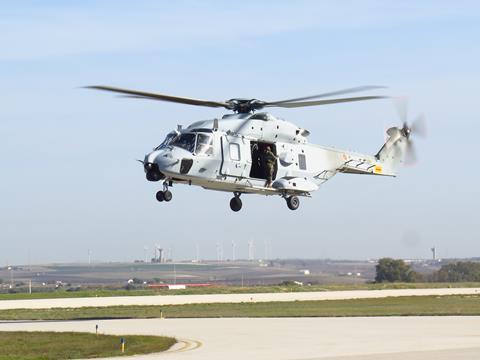
Madrid earlier this year signalled its intention to purchase another 32 NH90s, including six of the Maritime Spanish Transport (MSPT) variant for operation by its navy’s 14 Squadron.
A contract for those helicopters is expected by year-end, building on an earlier approval for a broader helicopter acquisition programme granted by Spain’s Council of Ministers in September.
But with one of 14 Sqn’s primary missions to support special forces operations, that purchase is likely to be for the Standard 2 configuration.
Critically, that will also include the distributed aperture system (DAS) to improve visibility in brown- or white-out conditions that has yet to be contracted by France.
Commander Javier Moreno, who leads 14 Sqn, says the next batch of six aircraft, complementing the seven already under contract, will be “another evolution” of the MSPT – a troop transport TTH variant modified with an automatic folding tail and main rotor blades, plus other customer-specific changes.
Moreno spent weeks earlier this year in France “flying the special operations aircraft” to experience the upgrades embodied in the Standard 2 configuration, including the DAS and Safran Euroflir 410 electro-optical/infrared sensor. “We will get all that on the second batch of aircraft,” he told journalists during a briefing at Rota naval base in southern Spain on 9 December.
Should Spain commit to the DAS it would make a French order more likely by allowing it to share the development costs.
The next six MSPTs will arrive later this decade, leaving the navy with two sub-fleets. Although differences between the two are “only very small”, Moreno says Madrid is considering whether to retrofit the initial batch of helicopters to the Standard 2 configuration.

Deliveries of the MSPT began in late July, with two examples ferried from the Albacete facility of NHI consortium member Airbus Helicopters to their new home at Rota, located near Cadiz on Spain’s south coast.
A third NH90 will be delivered in the coming weeks, says Moreno, to be followed by the remaining four helicopters from the navy’s first batch in 2026.
To declare initial operational capability (IOC) for the MSPT variant, 14 Sqn – only constituted in May last year – is following a seven-step process that should culminate in December 2026.
This will see the unit’s capabilities progressively increased, from its current level at step two, operating with land forces, through to an experimental fortnight-long deployment in southern Spain in March next year, to operations from a naval vessel – likely one of the service’s amphibious assault ships – then emabrked operations, to special forces support missions.
“Since this is going to be the most challenging milestone, we put it towards the end of the IOC process so we will be well trained by that point,” says Moreno.
Milestone seven – capping the IOC process – is “consolidation”, which will see two MSPTs permanently embarked on one of the navy’s ships.
Full operational capability (FOC) is then scheduled for the summer of 2028. The unit is simultaneously building up its numbers: at present it boasts just 16 pilots and 10 crewmen from a total of 81 personnel, against a goal of 145 people by FOC.
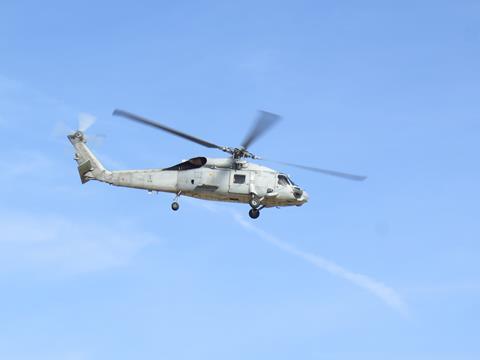
Spain currently uses a fleet of Sikorsky SH-60Fs, acquired second-hand from the USA, for the commando assault and special forces missions and these are likely to remain in service until the 2030s.
However, Moreno points to the substantial increase in capability offered by the NH90, including the ability to carry up to 20 troops, versus just six in the US-built type, alongside its fly-by-wire controls and newer avionics suite.
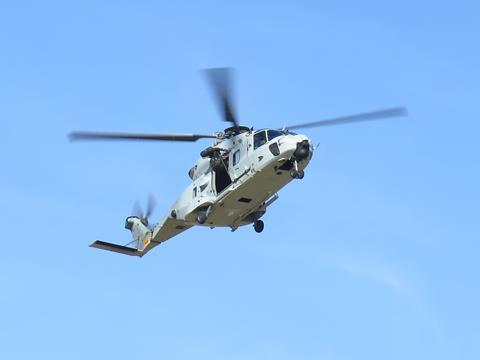
Additionally, Madrid has kicked off a process that could see it order a further batch of NH90s – its fourth overall – including those dedicated to anti-submarine and anti-surface warfare (ASW/ASuW) missions.
Designated the HSPN – Helicopter Spanish Naval – this would be largely based on the NH90 NFH variant ordered by France and Germany, such as the dipping sonar from the latter’s Sea Tiger, with the potential addition of domestically developed upgrades, says Belen Garcia Molano, vice-president, head of engineering at Airbus Helicopters Spain.
The airframer was last year contracted by the Spanish defence ministry to carry out a risk-reduction or “pre-design” study for the HSPN development, which was delivered on 4 December.
“The customer is now undertaking analysis and hopefully this will allow us to lead the Spanish companies ecosystem towards designing and producing an anti-submarine warfare version of the NH90 in Spain,” she says.
“Our team is managing discussions with the customer to focus on what they really need and for them to understand the technical solutions.”
Molano stresses there is as yet no development contract in place for the HSPN. “It is the clear intention of the government but there is no timetable,” she says.
It will be “up to the Spanish MoD to come back to us and propose the next steps”, she says. The Spanish navy currently uses the MH-60R for the ASW/ASuW mission.
Spain has so far ordered a total of 43 NH90s: seven for the navy, 24 for the army and 12 for the air force. All are powered by GE Aerospace CT7-8A engines.
Meanwhile, the Netherlands has confirmed a long-anticipated order for three more NFHs, plus two options.
To be assembled by NHI partner company Leonardo in Italy, the three units will be built to the latest software release 3 standard and join the Netherlands’ 19-strong fleet.
The Dutch defence ministry says it expects the three new helicopters to arrive in 2030, while its existing fleet will be raised to the same standard via a mid-life update.