












Some pilot trainees for the US Navy (USN) and US Coast Guard will now receive basic rotary-wing flight instruction using the Robinson TH-66 light-single.
Robinson and contracted flight training provider Helicopter Institute on 29 October announced a partnership to phase in Robinson’s TH-66 Sage – a derivative of the commercial R66.
The move follows a similar demonstration programme with the US Army that saw trainees undergo contractor-run basic rotary-wing instruction on the TH-66, rather than with the army’s government-owned fleet of Airbus Helicopters UH-72As.
“The robust nature and reliability of the R66 platform… make the TH-66 Sage an ideal aircraft for developing the next generation of military aviators,” says Randy Rowles, president of Helicopter Institute.
“Together, we’re shaping the future of rotary-wing training and advancing safety, capability and performance across the fleet,” he adds.
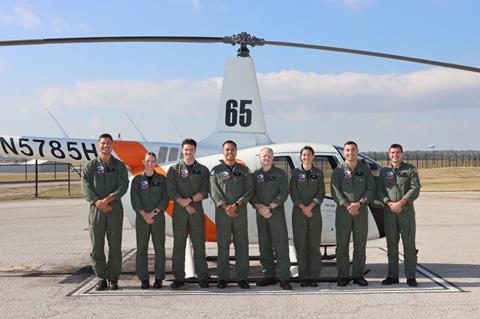
Although the USN’s primary helicopter trainer is a government-owned fleet of 120 Leonardo Helicopters TH-73As, the service also contracts with Texas-based Helicopter Institute to provide private flight instruction.
The navy inked a deal with Helicopter Institute in 2023 to outsource a portion of its initial helicopter pilot training under a programme dubbed Contractor Only Pilot Training – Rotary (COPTR).
The COPTR curriculum was notable in that it allowed students to bypass the traditional requirement of first gaining fixed-wing certification and move straight into rotary-wing instruction.
That programme, which is housed in Fort Worth, Texas, served as the inspiration for the recent US Army demonstration effort. Naval trainees enrolled in the COPTR option previously received instruction using the Bell 206B3 Jet Ranger, which is now being phased out by Helicopter Institute.
“Our relationship with Helicopter Institute demonstrates our ability to better prepare our nation’s pilots by delivering a modern, cost-effective platform that maximises critical training hours,” says Robinson Helicopter chief executive David Smith.
“With ready parts availability and support directly from our factory, we ensure exceptional operational efficiency, so our military students never spend one minute on the ground that is not necessary,” he adds.
Robinson assembles the R66 in Torrance, California. That factory is notable for its high degree of vertical integration, with Robinson not only designing and manufacturing the aircraft, but also forging its own mechanical parts, and cutting and shearing sheet metal.
The company says 85% of R66 parts are fabricated at the Torrance site.
Robinson hopes the TH-66 will ultimately supplant the UH-72A as the army’s primary trainer.
The service is looking to replace its current instructional model with a new set of contracts that will cover both training services and the operation and sustainment of a new trainer fleet.
Robinson is among a crowded field vying for the contract, known as Flight School Next.