












As a man once said: “She may not look like much, but she’s got it where it counts, kid.”
OK, in this instance it was a Star Wars character referring to a fictional spaceship, but the same appearances-are-only-skin-deep mantra could just as easily be applied to Leonardo Helicopters’ Proteus technology demonstrator.
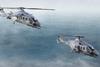
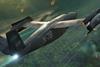
The result of a four-year, £60 million ($81 million) development on behalf of the UK Royal Navy (RN), the Proteus is not, if we are honest, the pretiest picture.
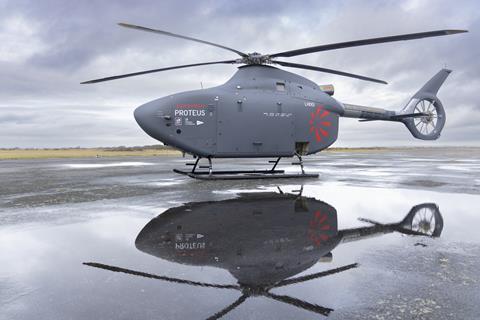
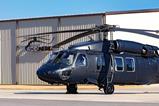
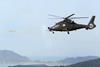
All flat grey paint and awkward angles, it looks strangely like an oversized anvil to which someone has attached a helicopter’s drivetrain and then mounted it on landing skids. Mind you, from the side, with its cavernous cargo bay gaping open, there is a strong sense of sinister delivery van there too.
But, says James Kneller, avionics chief project engineer, uncrewed air systems, Leonardo, it is easy to “get too hung up on what it looks like”, and fail to appreciate the clever stuff under the skin.
“What’s harder to see – but much more important for the customer – is the generational step we are taking on this platform in terms of autonomy,” says Kneller.
What he calls the platform’s “brain” allows it to take off, perform tasks – surveillance, sonobuoy deployment and so on – and then return to its mother ship, all without the need for human intervention. While it will communicate with its base station, sending back automatically acquired images or other data, it can also talk to other deployed assets, taking on or offloading missions as required.
Extensive simulations run by Leonardo have two or three Proteus aircraft working in concert to protect an aircraft carrier battle group or tackle a submarine threat.
Leonardo’s guiding principle – shared by much of the uncrewed industry – is that such a platform should “give the customer more capability at a lower cost”, although for capability one can also read affordable mass. It is worth noting that Proteus is not a remotely piloted air system – it flies itself – therefore multiple aircraft could be monitored by a single person, achieving the increase in mass and an effective cost reduction.
Extensive simulation also preceded the first flight, allowing the company to have a high degree of confidence in how the Proteus would fly. “We spent a year testing the software before we flew it for the first time,” he says.
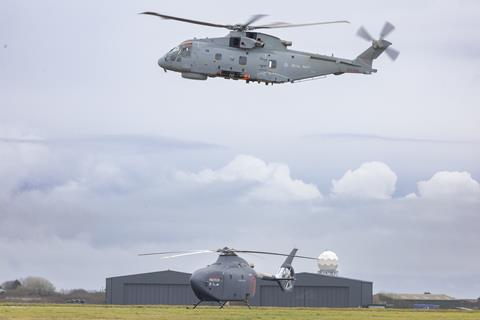
Data from the Proteus’s short flight-test career – two flights in January totalling about 15min – is “really close” to Leonardo’s predictions, Kneller adds. Due to the direction of the main rotor, the simulation showed it “lurches to the left” on take-off, “and the real aircraft did exactly the same thing”. Of course, it is not clear if or when Proteus will fly again.
Although clearly focused on the avionics and flight-controls, Kneller thinks Proteus’s value transcends a single discipline.
“This programme has not just been about the technology, it’s been a catalyst for this company to modernise, to become more agile and learn what it takes to design this kind of autonomous system for the future,” he says.
In fact, that accomplishment has been recognised by the wider company, says programme manager Michael Schunke, with the project team recently receiving Leonardo’s global innovation award.
Schunke, as you might expect, is keen to avoid dwelling on the look of the platform, or the origin of some of its components, instead emphasising the lessons the company has taken in how to design, build, certify and support such a platform.
Proteus uses what Leonardo coyly refers to as “commercial off-the-shelf” components, by which it means the drivetrain, main and tail rotors, and engine from its own AW09 light-single (although it remains almost pathologically opposed to mentioning their origin).
In fairness, those parts were used solely to derisk the development of a programme with which to test autonomous capabilities and, as the company reiterates, it does know a thing or two about successfully building aircraft.
But Schunke is keen to stress the differences from the rest of Leonardo’s rotary-wing line-up, pointing out that the Proteus has been designed without pilots from the outset.
“Any crewed platform that’s turned into uncrewed will take with it the parasitic weight, that parasitic mass – all the disadvantages of being crewed will pull forward with you,” he says.
“You can’t draw parallels with a crewed system,” he says. “It’s not going to follow the same certification path as an AW09, for example.”
In-service support could also be less costly if there is no need to worry about crew survivability, he says: “There is an opportunity here to look again and do things very differently to crewed aviation.”
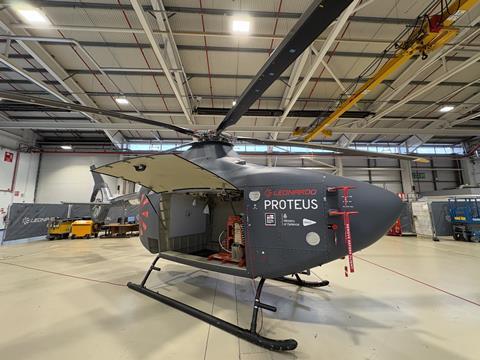
A final assembly line might also look different, he says, an element the airframer has studied as it considers how to industrialise the platform: “If you simply cut and paste everything from a crewed platform you would be taking on unnecessary cost.”
But above the technological or industrial considerations, Schunke thinks there is another impact too: “Aside from delivering what you have seen it is also about upskilling the workforce here in Yeovil – it will be able to work on uncrewed platforms and develop autonomous systems.
“It’s a highly skilled, highly performing team that has got an aircraft to flight in record time.”
A fundamental change of that nature might be what the factory needs in the long term.
“Where we see Yeovil in the next five to 10 years – we want to become the centre of excellence for autonomy going forward,” says Adam Wardrope, vice-president of market development for Leonardo Helicopters in the UK.
Of all the visions for Yeovil’s future – including managed decline – Wardrope’s does not lack ambition.
It would build on the experience the site has gleaned from Proteus and other uncrewed platforms, repositioning the plant as a high-tech, future-facing facility rather than one where ‘traditional’ manufacturing rules the roost.
But with production of a future autonomous helicopter in any meaningful quantity unlikely to happen much before the mid-2030s, the challenge is to keep Yeovil alive long enough for that hoped-for-future to remain a possibility.
It is, of course, no secret that the sprawling factory needs new work: new orders for its mainstay products, the AW101 and AW159 Wildcat, have dwindled and the big opportunity, the UK’s New Medium Helicopter (NMH) programme, remains mired in governmental limbo.
Leonardo Helicopters’ AW149 is the sole remained candidate for NMH, a £1 billion programme for a reported 24 helicopters, which was meant to transition to a contract last autumn.
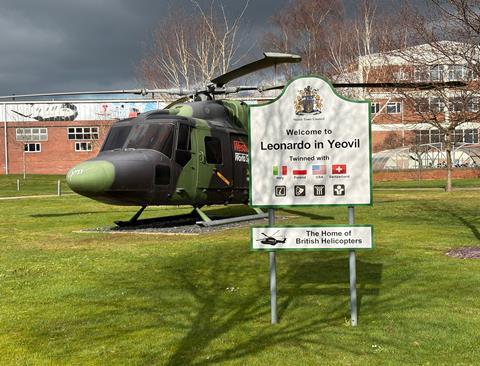
However, NMH has become ensnared in the long-overdue Defence Investment Plan (DIP), casting doubt on the programme’s progress. And time is running out, with Leonardo’s best and final offer to expire on 1 March.
Should the Anglo-Italian airframer prevail then an order will provide a vital lifeline for Yeovil, seeing it build helicopters for both the UK and export.
If not, then Leonardo chief executive Roberto Cingolani has warned it would have to review the future of the factory, putting around 3,000 jobs at risk; the company could not “subsidise Yeovil forever”, he said.
Hosting AW149 production would “allow us to retain some of those skillsets and engineers on site to allow us to build something like Proteus”, says Wardrope.
While insiders say a wholesale closure of the plant is unlikely – in-service support and mid-life upgrade work for the UK armed forces will still need to be performed – there would still be deep cuts to the engineering and production workforce.
In that scenario, can Yeovil sustain itself for the next five or 10 years until a Proteus successor arrives, assuming there even is one?
Wardrope remains confident, however. “Yes, it could if we remain at the same size and deliver the same output we deliver now.”
Beyond the headline-grabbing final assembly, Yeovil also houses a customer supply and training facility, and designs rotor blades and transmissions for other helicopters within Leonardo’s line-up. Strong links with local colleges and universities also guarantee a pipeline of graduates and apprentices.
“If all that remains as it stands now, then there is no reason why we couldn’t just swing into delivering [a Proteus successor] in that way. If there was any size of reshaping then we would have to reconsider how we might do that,” he says.
What comes next is not yet clear, but the RN has been transparent in its desire to move to a “hybrid” service – where dull, dirty and dangerous tasks are performed by autonomous systems.
A successor aircraft will probably look little like Proteus; it is likely to be bigger, for one, and will almost certainly require a twin-engined powertrain, rather than the current iteration’s single turboshaft. Oh, and wheeled landing gear in place of the skids that make it ill-suited for embarked operations in high sea states.
But until the DIP is published the RN’s hands are tied. And in the meantime, just like Proteus, Yeovil remains all at sea.