












Piasecki plans to offer an expanded version of its Kargo uncrewed logistics platform with significantly improved payload and range.
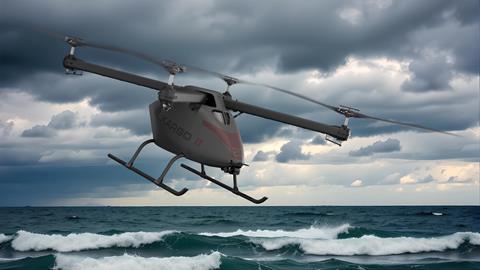
Dubbed the Kargo II, the latest variant will retain the quadcopter rotor system and form factor of the original Kargo design, but with double the payload capacity.
The Kargo II will offer the ability to transport 680kg (1,500lb) of payload, versus a maximum of 363kg in the developmental Kargo. A new optimised shaft-driven transmission and larger rotors will enable the increased performance, as well as improved range and airspeed.
“Kargo II reflects Piasecki’s commitment to rapidly advancing autonomous vertical-lift capabilities,” says John Piasecki, chief executive of Piasecki Aircraft.
“With the launch of this first major development spiral, we’ve created a more capable, scalable solution for autonomous logistics, designed to meet the evolving requirements of defence and commercial customers alike,” he adds.
Piasecki acquired the Kargo concept from industrial conglomerate Kaman earlier this year.
Kaman had initially pitched the Kargo to the US Marine Corps (USMC) as a medium-lift, autonomous vertical take-off and landing option for resupplying expeditionary forces on remote islands in the Indo-Pacific.
The company subsequently completed demonstration contracts with both the USMC and US Army, including a 2024 flight test, but failed to secure any large-scale orders for the Kargo.
After being acquired by a private equity firm in 2024, Kaman began looking for buyer interested in taking over the product line.
At the time, Kaman described the divestment as a strategic decision to ensure the Kargo technology “finds a home where it can thrive”.
Piasecki is attempting to push the Kargo design out of development and into active production, relocating the project to the company’s Heliplex rotorcraft production and modification centre in Coatesville, Pennsylvania.
From there, the company has said it plans to assemble production-ready Kargo vehicles as soon as late 2026. In the meantime, Piasecki is seeking certification from the US Federal Aviation Administration for commercial use, while simultaneously targeting military customers.
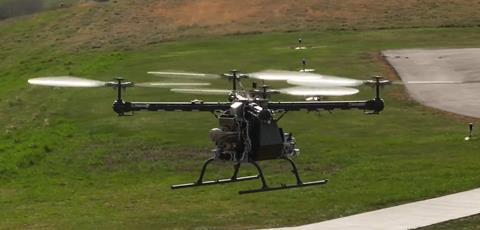
Piasecki is sounding bullish on prospects for both variants of the uncrewed quadrotor, projecting future demand for more than 300 aircraft across defence and commercial applications for the Kargo and Kargo II.
“Kargo II is a direct response to operator feedback, validated use cases, and real-world mission needs,” says Romin Dasmalchi, director of cargo UAS programmes at Piasecki. “We’ve engineered a platform that offers the range, lift, and reliability that commercial operators and military planners have been asking for.”
On the commercial side, Piasecki says it is targeting sectors including energy, logistics, disaster response, and remote infrastructure support, “where legacy helicopter operations are often cost-prohibitive or logistically constrained”.
Commercial availability for the updated Kargo II is planned for late 2027 in both domestic and international markets, subject to production and certification milestones.
For defence, the USMC remains a promising contender under the Marine Corps Autonomous Resupply Vehicle – Expeditionary Logistics (MARV-EL) programme, which provided Kaman a $12 million contract to support design and prototyping of the Kargo.
That effort completed a performance evaluation in July 2024 that saw the Kargo and a competing vehicle from Leidos-Elroy Air complete demonstration flights.
Requirements for the MARV-EL programme included transporting at least 136kg for more than 50nm (92km) with fully autonomous take-off, landing and waypoint navigation. Kargo II offers a range of 850nm.
The USMC is also exploring the potential for converting conventional utility helicopters into uncrewed logistics support vehicles.
That progamme, called Aerial Logistics Connector, is funding the development of two prototypes: an Airbus-led effort using the H145-based UH-72, and the team of Near Earth Autonomy and Honeywell, who are modifying a Leonardo Helicopters AW139.