
















Israeli defence technology firm Rafael is touting the recent battlefield deployment of its Iron Beam air defence system as proof that laser weapons have finally come into their own.
The ground-based directed energy system has been integrated into Israel’s much lauded Iron Dome air defence system – another Rafael product – including combat use during missile and drone attacks launched by Iran in 2025.
The Iron Beam was declared operational in late 2025 after completing final tests.
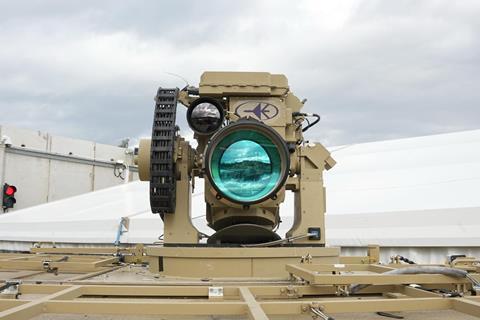
For decades, lasers have dangled the tantalising prospect of an air defence system with essentially unlimited ammunition and a cost-per-shot drastically lower than protections based on missile interceptors.
The concept was famously pursued without success by the United States for intercontinental ballistic missile defence under the Reagan-era Strategic Defense Initiative – colloquially known as Star Wars.
Prolific author of military fiction Tom Clancy envisioned the development of an equivalent laser weapon system by the Soviet Union as a central plot line in his classic espionage tome The Cardinal and the Kremlin.
The Pentagon’s Star Wars never got off the ground, and Clancy’s work of imagination was arguably the closest directed energy ever came to real world deployment – until now.
“It has jaw dropping capabilities,” says Yoav Tourgeman, chief executive of Rafael. “We have intercepted a variety of targets, very easily, from very long ranges.”
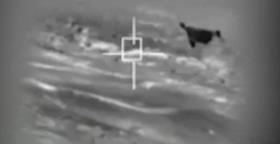
The electrically powered solid-state laser at the heart of Iron Beam offers effectively limitless ammunition, Tourgeman adds. The directed energy approach also offers instantaneous battle damage assessment and no risk of additional debris created by interceptor missiles.
Iron Beam also offers scalable power output and more precise targeting, allowing frontline operators a range of options for engaging an incoming threat.
Perhaps most importantly, an individual laser shot is orders of magnitude cheaper than firing a precision guided missile, and also not encumbered by production limits.
“We have flipped over the equation of defence,” Tourgeman says of the Iron Beam approach. “It costs nothing.”
Although Tourgeman took the helm at Rafael in 2023, he says the company has spent the past 30 years investing in and developing the technology that makes Iron Beam possible.
Among the many physics challenges the company faced were maintaining beam focusing over significant distances, optical distortion, and high-speed targeting.
Notably, some of those same physics problems were being churned through by Tom Clancy’s fictitious Soviet engineers in their secretive research station high in the mountains of Tajikistan.
Israeli scientists at Rafael overcame those hurdles in real life, with Tourgeman touting the result as a paradigm shift in ground-based air defences.
Rafael is now delivering Iron Beam units at full rate production for the Israel Defense Forces, including truck-mounted mobile units, although the company declines to provide specific figures.
The company is also exploring export options, pending approval from the Israeli government.