












Italian investigators have disclosed that an Airbus A320 descended to just 41ft above the sea after take-off from Catania in September, as the captain made nose-down pitch inputs during the initial climb.

The crew of the Air Arabia Maroc aircraft – which departed from runway 08, towards the sea, on a moonless night – managed to recover its trajectory after ground-proximity warnings sounded.

Investigation authority ANSV believes take-off performance data was not entered into the flight-management system before departure.

Just six occupants, comprising two pilots and four cabin crew, were on board the twinjet (CN-NML) which was operating a maintenance positioning flight to Amman on 20 September. No-one was injured.

ANSV says that, based on the aircraft’s configuration, the take-off should have involved rotation at 131kt and a V2 climb speed of 133kt.

“Based on the preliminary information available…these were not inserted in the [multifunction control and display unit],” it states in preliminary findings.

The aircraft’s Thales flight-management system had not been modified with a software update which cautions the crew if take-off speeds have not been entered.

Maroc incident-c-ANSV

Source: ANSV

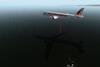
Simulation of the occurrence illustrates the proximity of the A320 to the sea surface before its recovery

ANSV says the aircraft started its take-off roll at a ‘flex’ thrust setting, but this was increased to ‘take-off/go-around’ power after a few seconds.

As the aircraft accelerated it reached 144kt before rotation was initiated, and it lifted off at 157kt. Even though no sidestick input had been applied during the take-off roll, the nose-gear was twice recorded as uncompressed.

The A320’s speed reference system, which automatically maintains speed through pitch control during initial climb, would normally have been engaged – but only if the V2 reference speed had been entered into the flight-management system.

After becoming airborne the aircraft climbed at a shallow pitch of no more than 11°, compared with the typical 15° listed in the operating manual.

Without the speed reference system activated, the aircraft’s flight-director switched to ‘vertical speed’ mode, as designed, with a target of 1,900ft/min. The vertical speed at the time was 1,968ft/min, and the autopilot had not been engaged.

At a radio-altimeter height of about 123ft the captain started making nose-down pitch inputs.

Some 6s later, the flight-data recorder captured more persistent nose-down inputs from the captain’s side.

The aircraft levelled at about 383ft and began to transition to a descent.

Its autopilot was briefly engaged for about 3s but, during this period, the vertical speed target changed to a descent rate of 1,900ft/min, sidestick movements continued to be recorded, and the thrust setting was reduced to idle for about 4s.

The crew received ‘sink rate’ and ‘pull up’ alerts from the ground-proximity warning system as the aircraft descended from 290ft to 250ft with a descent rate reaching nearly 2,800ft/min.

As the warnings sounded, with the aircraft at 162ft, take-off thrust was re-applied and the captain’s sidestick fully deflected to command nose-up pitch.

This served to arrest the descent but the A320’s momentum meant it reached a radio-altimeter height of 41ft above the Ionian Sea before it began to climb.

Its autothrust and ‘open climb’ mode – although not the autopilot – were engaged at 737ft, a nose-up pitch of 12.7°, and a climb rate of 5,800ft/min.

Catania’s control tower is not equipped with minimum safe altitude warning system, says the inquiry.

The aircraft proceeded to Amman without further incident but the length of the flight meant cockpit-voice recorder information from the event was overwritten.

ANSV has not reached formal conclusions about the incident, but says the inquiry expects to focus on possible spatial disorientation – which could include the effects of somatogravic illusion – as well as possible human-machine interface issues, organisational elements, and technological barriers.

Air Arabia, it states, has since taken a number of safety actions including expediting the flight-management software update and reinforcing simulator training for early recognition of instances where take-off speeds have not been entered.