













Russian investigators have urged carriers to reinforce training for pilots on the displayed altitudes on airport charts – as well as procedures for setting QNH or QFE altimeter references – following the fatal terrain collision involving an Angara Airlines Antonov An-24.
The Interstate Aviation Committee’s newly-issued preliminary findings from the 24 July accident near Tynda airport confirm the aircraft was following the BELIM 2A arrival pattern, inbound from the southeast.
Its crew was given the QNH pressure reference of 751mmHg (1002hPa) for Tynda at 12:43, as the aircraft flew northwest towards the airport with the intention of joining the circuit and landing on runway 06.
A few seconds later the air traffic controller also offered the captain a QFE reference, which the captain accepted. Tynda has an elevation of 616m and the QFE reference was 699mmHg.
The cockpit conversation indicates that the crew set the altimeters to the QNH reference.
Weather conditions at the time featured a low cloud base of about 200m.
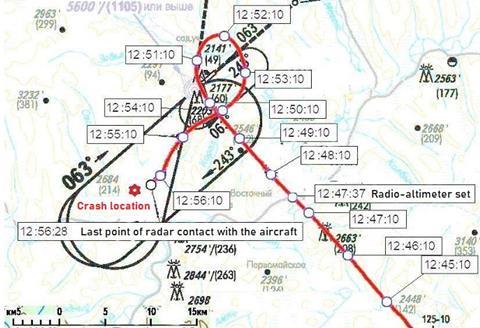
Shortly after 12:50 the crew reported passing the NDB navigation aid at 1,100m, still heading northwest, and commenced a tight three-quarter right turn. The charts give this figure as a QFE reference of 1,105m, while the QNH reference is listed as 5,600ft (1,700m).
The first officer then referred to a target of 745m. This appears consistent with the 740m height figure on charts – again based on a QFE reference – ahead of the turn towards final approach.
After rolling out from the turn the aircraft was heading southeast but not aligned with the southeast flightpath on the approach circuit. The controller appeared to mentioned to the crew that they were slightly off course, a remark acknowledged by the captain.
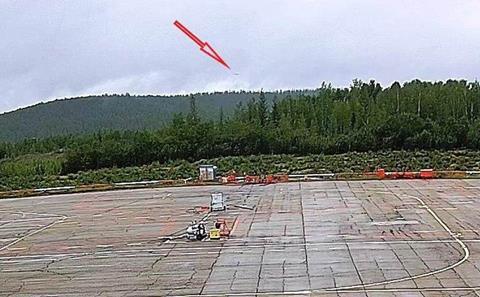
An surveillance camera captured the aircraft passing south of the airport, during a gap in the cloud, prior to the planned 180° turn to final approach.
Some 2min later, says the inquiry, cockpit-voice recorder information picked up an audio signal from the radio altimeter and an automated alert from the ground-proximity warning system.
The aircraft’s right wing struck a 15m tree on terrain rising to some 750m above sea level.
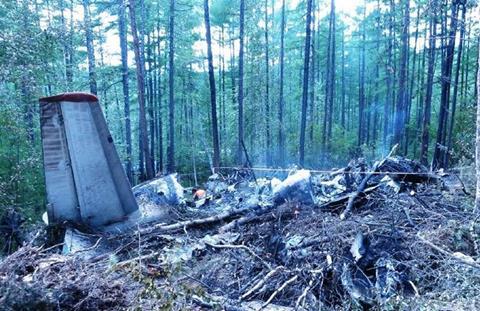
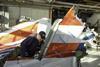
Parts of the wing broke away, and the An-24 banked 135° to the right, entered a 20° dive, and crashed on the downward slope. The aircraft came to rest 14.7km from the airport and 3.5km from the extended runway axis.
None of the 42 passengers, four crew members, and two Angara engineering personnel on board the aircraft survived.
Although the Interstate Aviation Committee has yet to reach formal conclusions about the crash, it has additionally recommended strengthening crew training for altitude monitoring during approach, and actions when radio-altimeter and other height warnings are triggered.