













Czech investigators have disclosed that a Boeing 737 crew levelled the aircraft at a low height on approach to Marsa Matruh airport in Egypt, after descending on final approach with an incorrect altimeter pressure reference.
The captain had been alone in the cockpit when he requested a QNH reference from air traffic control.
Although he read back the setting as 1014hPa, the actual QNH figure was 1004hPa, says Czech investigation authority UZPLN.
ATIS information was unavailable, it states, adding that the datalink function was “limited” and communication readability was “poor”.
The air traffic controller did not correct the readback.
As the aircraft progressed with a continuous-descent VOR/DME approach for runway 33, the captain and first officer “did not check” the reference.
“They accepted the information and considered it correct,” says UZPLN.
This led the aircraft to dip some 280ft below the vertical descent profile for the approach, in conditions of “impaired” visibility.
UZPLN says the precision-approach path indicator lamps were visible only 2nm from the runway, a distance at which the crew received a ground-proximity warning.
Upon realising the jet was too low, the crew interrupted the descent and, while maintaining visual contact with the ground, levelled the aircraft and flew horizontally for about 1nm.
Analysis indicates that about 11s of this 21s horizontal flight was conducted less than 260ft above terrain.
After intercepting the correct vertical profile, the crew proceeded to land.
While UZPLN has not identified the airline, schedule analysis indicates the aircraft involved was a Smartwings 737 Max.
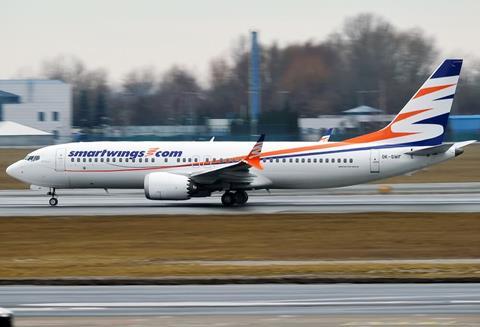
The European Union Aviation Safety Agency has recently alerted carriers to the importance of barometric altimeter setting, in a safety bulletin of 22 October.
EASA issued the bulletin in response to findings from occurrences including the descent of an Airbus A320 almost to ground level on approach to Paris Charles de Gaulle in May 2022.
“Serious incidents have highlighted a concern on the effects of incorrect barometric altimeter settings when operating below the transition level,” it states.
“Procedures relying on the use of barometric altimetry have been used for many years and have considerably improved safety by offering vertical guidance to runways, which were previously served with 2D instrument approach procedures or even visual approach procedures.”
EASA highlights that incorrect settings could “severely affect” safety margins protecting a variety of approach procedures including those flown using continuous-descent final approach techniques.