











US investigators believe a tyre burst that damaged a United Airlines Boeing 737 Max 9 was caused by brake application before all three landing-gear were on the ground.
Both right-hand main-gear tyres burst as the jet touched down at Houston on 24 October last year, and the fragments struck and dented the fuselage.
The autobrake and anti-skid systems had been on the minimum equipment list prior to departure from Las Vegas. This led the pilots to review operational limitations and weather conditions during the flight.
Given a slight tailwind component on Houston’s runway 26L, the crew requested an opposite-direction landing. But Houston approach control could not grant the request owing to traffic and airspace restrictions.
When the winds were later reported as calm, the crew conducted a visual approach to 26L, for which the final wind check showed an 8kt crosswind from the left.
“After the wheels spun up upon touchdown, the speedbrakes activated,” the captain, who was flying, testified to the National Transportation Safety Board.
“With the anti-skid deferral in mind, I applied brake pressure and [thrust] reversers. After this, I felt that something was wrong.”
The first officer perceived the aircraft was “skidding” and told the inquiry that, as the aircraft slowed, the “skidding turned into grinding”, with the aircraft “leaning right wing down”.
Both pilots believed a tyre had burst, and the tower controller informed the crew that he had seen smoke from the jet during the landing roll.
Flight-data recorder information showed that brake pressure started to rise, to 500psi, before the right-hand main-gear air-ground switch changed to ‘ground’ mode.
The brake pressure continued rising after the right main gear touched down, peaking at 1,500psi as the left main gear made contact, before easing to 1,000psi with the lowering of the nose-gear.
About 1s later, the data shows motion evidence consistent with failure of the right main-gear tyres.
“Brake application happened before all three landing gear had changed to ‘ground’ status, and likely before the wheels had an opportunity to fully spin up,” says the inquiry. “Early application of the brakes during the landing likely contributed to the failure of the tyres on the right [main gear].”
None of the 145 occupants was injured. Passengers disembarked by stairs about 40min after landing.
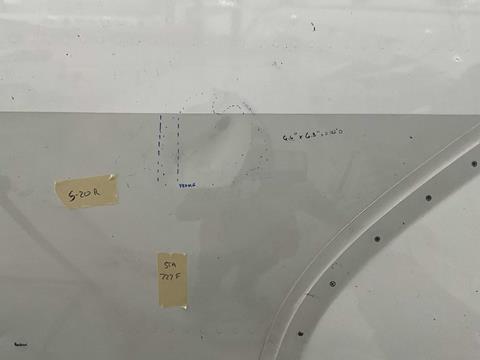
But inspection of the aircraft (N27515) revealed impact denting on the fuselage, in an area considered a principal structural element, requiring techniques from the structural repair manual to address the damage.