











US investigators have yet to determine why a UPS Boeing MD-11F failed to climb away from Louisville after shedding an engine on take-off.

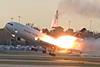
Preliminary findings from the National Transportation Safety Board confirm the left-hand GE Aerospace CF6-80 engine and pod broke away on rotation, being flung backwards over the wing and fuselage, while fire ignited at the wing attachment point.

Radio-altimeter data indicates the MD-11F may have gained as little as 30ft of height before coming down in an industrial area south of the airport.

“A witness in the [Louisville control tower] reported that the take-off speed appeared normal for that type of aircraft,” says the inquiry. “However, the climb rate was not normal, as the airplane did not climb above the tower’s height of approximately 200ft.

“Another witness reported that the airplane stopped climbing and began to lose altitude before rolling slightly to the left.”

Even after the complete loss of the left engine and pod, which would have weighed around 5t, the aircraft should have had sufficient reserve thrust.

The preliminary findings do not elaborate on the reasons for its failure to climb; the inquiry has yet to disclose whether either of the aircraft’s other two engines was affected, by the separation or another contributing factor.

UPS engine separation-c-NTSB

Source: NTSB

Investigators have not disclosed whether other engines were affected during the accident sequence

But a possible knock-on power loss from a damaged engine is not unprecedented; a serious occurrence at Newark, 25 years ago, illustrated the potential for contagion.

After reaching the V1 decision speed, a Continental Airlines McDonnell Douglas DC-10-30 suffered an explosion in its left-hand CF6-50 powerplant during its take-off roll on runway 04L in April 2000.

Investigators traced the uncontained failure to a stress rupture of anti-rotation nozzle locks in the second-stage low-pressure turbine.

But examination of the aircraft revealed “all three engines” were damaged, says the inquiry. The right-hand engine had sustained leading-edge damage to all its fan blades, with “tears, rips and material loss”.

“Pieces of fan blade, and material similar to that of the [second-stage] nozzles from the [left-hand] engine, were found embedded in the engine inlet acoustic panels,” the inquiry added.

The DC-10’s centre engine – mounted in the vertical fin, like the MD-11’s – also showed evidence of leading-edge damage to some of its fan blades.

With the failure occurring at the critical V1 threshold, the crew committed the aircraft to flight and the DC-10 lifted off, with the left engine having lost 30% of its N1 speed.

The other two engines appeared to be operating normally but, as the aircraft climbed towards 3,000ft, an airframe vibration emerged. When the jet levelled, the crew found that the vibration disappeared when the right-hand engine speed was reduced.

Both wing-mounted engines remained at reduced power, relative to the centre engine, for the rest of the flight. As part of the preparation for landing, the crew ran checklists for both single-engine and two-engine failure scenarios.

The aircraft landed safely with no injuries among the 220 passengers and 14 crew members.

But the investigation determined that that debris from a casing breach of the left-hand engine “resulted in collateral damage” to the other two powerplants – as well as the fuselage, and the left-hand main landing-gear.

Investigators of the UPS accident on 4 November have still to confirm the initiating sequence behind the engine separation. But the take-off roll to the point of rotation was “uneventful”, says the safety board, and examination of the left-hand engine pylon has revealed evidence of fatigue cracks in the aft mount that attaches the pylon to the wing.