












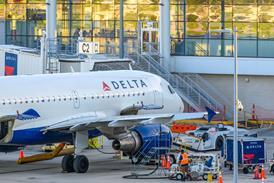

The UPS Boeing MD-11 cargo jet that suffered a wing-engine separation during take-off in Louisville, Kentucky on 4 November apparently failed to gain more than 100ft of altitude, rather than a previously disclosed altitude point of 475ft.
Todd Inman, a member of the US National Transportation Board (NTSB), said during a local media briefing on 7 November that ADS-B data had indicated the freighter reached an altitude of 475ft – as the agency reported the previous day – but that estimate is now likely inaccurate.
“When considering how FAA ADS-B altitude is reported, this equates to approximately 100ft above ground level,” he says. “This is what we consider the most accurate, but I will say we are corroborating that with the data from the flight recorder, which… will take several days to be validated.”
Precise information is often slow to emerge in the aftermath of a major accident, such as the MD-11 trijet crash in question, which killed three crew and at least 10 people on the ground.
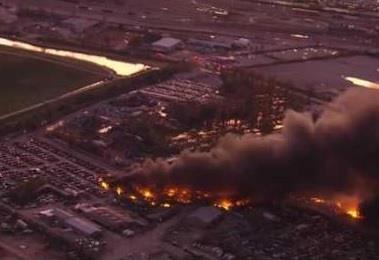
Investigators say the jet’s flaming left-side GE Aerospace turbofan detached as it was taking off from Louisville International airport runway 17R, headed for Honolulu as flight 2976.
The NTSB said on 6 November that the aircraft reached a maximum speed of 183kt (339km/h) before impacting several local businesses, producing a huge column of fire and black smoke.
Investigators are still reviewing more than 2h of cockpit voice recorder (CVR) data, which the NTSB considers “good quality digital-recorded audio”, Inman says.
“In reviewing that audio, the crew completed their standard checklists and briefings in preparation for the flight,” he says. “The take-off roll was uneventful through the different speed call-outs. About 37s after the crew called for take-off thrust, a repeating bell was heard on the CVR, which persisted until the end of the recording 25s later.”
The NTSB infers that the bell stopped at the “final point of impact”, Inman says. But it is still sorting through 400 sets of flight recorder data to determine a more-precise timeline of the accident, and declines to identify the consistent bell heard in the cockpit as an alarm.
”We have a working theory right now, and we’re trying to validate that against the FDR data,” Inman says. ”With the corroborating evidence in regard to the video that we have, is obviously leading us to know that there was a fire occurring.”
The FAA and the NSTB are also looking at records of the MD-11’s recent heavy maintenance check in San Antonio. The agencies are seeking more information on what work was performed there.
On 6 November, investigators combing the runway in Louisville found multiple blade fragments from the aircraft’s left-side CF6 turbofan.
“In regarding to the plane itself, the bulk of the left engine pylon was still attached to the left engine when the engine separated from the wing,” Inman says. “Both of those components are in a secured facility… and undergoing further examination.”
The NTSB says more than 500 investigators and first responders have contributed to the early crash probe.