












In a year of mixed fortunes for ATR, the turboprop manufacturer netted 50 orders in 2025 but fell short of its production target, delivering 32 aircraft, three fewer than 2024.
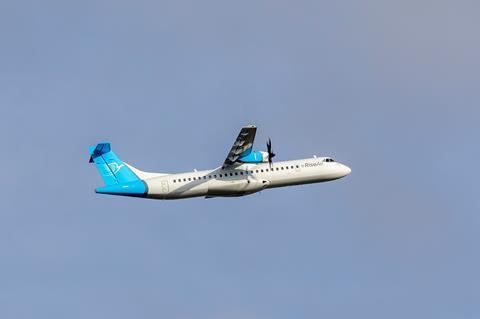
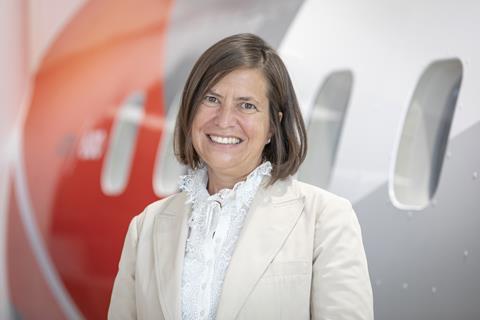
However, chief executive Nathalie Tarnaud Laude vows 2026 will be a “transition year” as the Franco-Italian airframer prepares to relaunch a second final assembly line (FAL) and finally resolve many of the supply-chain challenges that have bedeviled it since the pandemic.
“I am confident [2026] will be a year of ramp up,” Tarnaud Laude said during the Toulouse-based manufacturer’s annual results presentation on 18 February.
She notes that parts shortages have fallen by two-thirds over the past 12 months, and highlights the efforts ATR and its owners Airbus and Leonardo have made to address capital shortfalls at troubled second- and third-tier suppliers.
Tarnaud Laude predicts that output will increase by a fifth in 2026 – which would take deliveries to around 38 – and that ATR’s annual production will reach 60 by the end of the decade.
There appears to be no shortage of demand for ATR 72-600 and 42-600 aircraft, with gross orders for 60 aircraft in 2025. An unnamed customer cancelled a commitment for 10 units, taking the net total to 50. ATR’s backlog stands at 160.
The tally included double-digit orders from Air Algerie and Uni Air, for 16 and 19 ATR 72-600s respectively.
“We are seeing a lot of confidence as we go into 2026,” says Tarnaud Laude. “We believe we now have a market that is back to right levels and we see a lot of growth in future.”
ATR still has some way to go to return to the order and delivery numbers it was achieving before the pandemic. In 2019, for instance, it received commitments for 79 aircraft and shipped 68.
’FAL North’ was shuttered in 2020 and has been dormant since. However, the business is about to begin a two-month trial with two aircraft produced “in parallel” with a view to the new line being fully on-line by May.
While Asia remains ATR’s biggest market, the company has high hopes of resurrecting its fortunes in North America, where its fleet has fallen sharply on the back of a decline in thin, ultra-short-haul routes.
Last month, so-called public charter airline JSX unveiled the first of four ATR 42-600s configured with 30 business class seats, which it will operate on routes including Santa Monica to Las Vegas.
Although the aircraft are not new, ATR believes the high profile of JSX will do much to reverse the perception of turboprop aircraft in the USA and help rebuild regional connections to underserved airports.
“JSX is a big breakthrough and could lead to a lot of traction,” says Tarnaud Laude. “In the USA, 30% of routes under 500nm have disappeared, and 500nm is the place where ATR can bring maximum benefit. I have a lot of ambition for the US, and this deal proves we can be successful there.”
Tarnaud Laude also says 2029 will be “a decision point” for ATR as it mulls possible disruptive-propulsion successors to its current products. It is taking part in two European Union Clean Aviation research and technology programmes to demonstrate a hybrid-electric ATR 72-600 flying testbed by the end of the decade.