













German start-up ERC System will in 2026 fly the first prototype of a vertical take-off and landing (VTOL) uncrewed cargo aircraft it hopes to bring to market in the coming years.
Critically, that aircraft will leverage systems and technologies – even re-using certain components – evaluated as part of a recent flight-test campaign for a future crewed passenger VTOL aircraft.
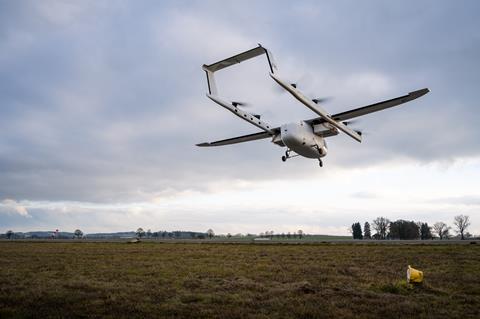
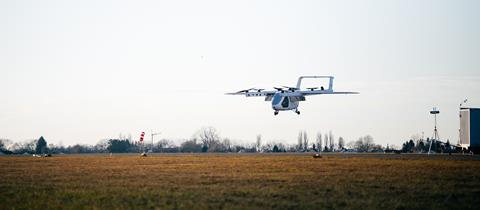
Taking place at an airfield near Munich in southern Germany, the programme used a “full-scale, full-mass” prototype – with a 2.7t maximum take-off weight and 16m (52ft) wingspan – called ‘Romeo’ for the hover testing.
Starting in November 2025, the campaign saw a little under 10 flights completed, which, due to airspace restrictions, each lasted no more than 5min.
Despite the low total flight time, ERC System argues that the tests were sufficient to validate the aircraft’s lift and cruise configuration and flight-control system.
Chief executive Dr David Lobl points out that as such aircraft are designed to only hover for limited periods, the short-duration flights were “not limiting – they left us sufficient time to collect good data”. The aircraft, he adds, has been “working very reliably”.
In addition, its product development builds on flights with an earlier full-scale prototype – ‘Echo’ – that took place in 2023.
ERC System has the option to continue flying ‘Romeo’ for a short period if needed, but it “will be replaced quite soon by the next version”, says Lobl.
But, explains chief commercial officer Max Oligschlager, replaced means more than simply superseded: “We will re-use components from Romeo [for the next demonstrator]. We still have a window for more tests but soon it will be dismantled.”
ERC System’s next prototype will be for its planned uncrewed cargo aircraft, due to fly this year, as it looks to tap into strong demand from the defence market and generate near-term revenue.
More details on the cargo drone – its size and capacity, for instance – will be disclosed in the second quarter, but Oligschlager says that while it will use the lift and cruise architecture “there will be some design changes” over the ‘Romeo’ demonstrator so that it is “tailored to the use cases that we target with the unmanned product”.
In fact, both the cargo aircraft and the future passenger VTOL platform will move away from the twin-boom design seen on the ‘Romeo’ aircraft. However, the eight lifting propellers will be retained.
Forward propulsion will come from a pusher propeller on the unmanned aircraft, while the passenger VTOL version will feature a tractor configuration to allow rear loading of the aircraft.
In both cases, the aircraft will use hybrid-electric powertrains, with a piston engine serving as a range-extender to allow customers to fly longer distances. “We don’t want to [have to] bet on future technologies,” says Oligschlager.
Under the company’s current schedule, its manned passenger aircraft, dubbed ‘Charlie’, will enter service around 2031, while the uncrewed cargo model will arrive “quite a bit sooner”, he adds.
The initial use case for ‘Charlie’ is inter-hospital patient transfers and ERC System is collaborating with German emergency medical services provider DRF Luftrettung to refine the aircraft for the mission.
ERC System sees its aircraft as complementing existing helicopter and ground-based patient transport options.
To date, the company has been bankrolled by its “strategic investor” – aerospace testing and certification specialist Industrieanlagen-Betriebsgesellschaft (IABG). However, ERC System’s longer-term plan is to seek additional partners.
While some may be purely financial, the firm is also seeking alliances with others in the aerospace ecosystem to enable industrialisation of its aircraft.
“When we think of strategic investors in the future, we are also thinking about those that have expertise when it comes to serialising an aircraft,” says Oligschlager.
“We need investors like IABG that understand this business and help us with more than capital.”
Such partnerships could also drive the ultimate location of its final assembly line, with the company not wedded to remaining in Germany. “We want to produce in Europe – we want to be a European OEM,” he adds.