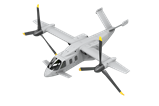













Vertical Aerospace chief executive Stuart Simpson claims the company will need under $700 million to bring its VX4 electric air taxi to market by 2028, citing its conservative spending plans and strong progress with the ongoing development programme.
Simpson delivered the bullish message during Vertical’s capital markets day event on 17 September in a speech peppered with sideswipes at its bigger and better-funded US rivals.

He says the UK firm is the “only company in the sector” with a clear path to certification thanks to its deep aerospace experience and alignment with the UK and European regulators.
“I genuinely believe that we are the only people in the industry with a true understanding of what we have to do and how we have to do it to bring an aerospace product to market.
“We are the only ones doing this in a rigorous, engineering-led way,” he says, adding: “We know what we are doing.”
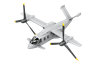
Flight testing of the VX4 is continuing from the manufacturer’s Cotswold airport base in southwest England, with the electric vertical take-off and landing (eVTOL) aircraft due to perform its critical transition flight before year-end.
Simpson describes this key “20 seconds” for the company as a “major technology and certification unlock” allowing Vertical to “drive through” the validation process.
Following his appointment as chief executive last year, Simpson carried out a root-and-branch review of Vertical and the VX4’s progress. This saw certification pushed back until 2028 as part of the company’s FlightPath 2030 strategy, which also detailed its planned production ramp-up and future financial performance – figures that have since been revised upwards.
But for all its flight-test progress, Vertical’s perennial problem has been access to finance. While rivals like Archer Aviation and Joby Aviation have regularly pulled in triple-digit millions of dollars investment, Vertical’s most recent funding round saw it raise a gross figure of $60 million – giving it a cash runway until the middle of 2026.
Simpson is undaunted, however, and says the amount Vertical needs to bring the VX4 to market is “guaranteed to be less than $700 million”.
He bases that on the fact that “75% of costs are contracted or quoted” which is “giving great fidelity on what it’s going to take to get there”.
Although acknowledging that $700 million is a “huge amount of money”, Simpson points out it is a “tiny amount compared to what our peers spend – a little more than they spend in a year”.

Certifying the VX4 to the equivalent standards adopted by the UK Civil Aviation Authority (CAA) and European Union Aviation Safety Agency (EASA) also means there will be “no late surprises” requiring a costly redesign.
“We are doing every single moment of flying to a higher barrier than anyone else in the world,” he adds.
CAA and EASA certification will also deliver an aircraft that is “capable of flying anywhere in the world from 2028”, noting that “we don’t have to go to the Middle East” to facilitate early adoption of the VX4 – a clear dig at Archer and Joby which have both pledged to begin early operations in region.
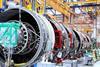
Vertical has also selected Cotswold airport as the location for its first production line. Sized to build around 25 aircraft per year, the facility will assemble initial low-rate examples of the VX4 before a new factory is established for full-rate production.
Although the company has previously trumpeted its ‘made in the UK’ credentials, it says it is considering “locations in the UK and beyond” for full-rate production of the aircraft and its batteries.
“While our preference is to base full-scale production in the UK, we are also assessing opportunities in other countries.
“A final decision will be made next year, guided by what best supports the company commercially and in terms of talent.”
Simpson highlights the “entirely modular, entirely scalable” production system as a key differentiator, saying the firm will not require a “white elephant – a big under-utilised, empty factory” in its early stages.
Archer’s already completed production facility on Covington, Georgia occupies 37,000sq m (400,000sq ft) and is expected to be able to build 650 aircraft per year by 2030.
That facility has been set up using expertise from major shareholder Stellantis, which owns car makers Citroen, Chrysler, Dodge, FIAT, and Peugeot; Joby, too, has been guided in its production strategy by investor Toyota.
But Simpson argues that assembling an eVTOL has “nothing to do with building a million Corollas or 700 Dodge Rams”, instead it has “everything to do with building… a supercar” like a McLaren or Ferrari.
“We will scale as we grow – we do not need to waste a dollar,” he adds.