













UK competition regulators cleared Boeing’s acquisition of Spirit AeroSystems after concluding that the sale to Airbus of parts of the aerostructures supplier’s operation would prevent any market distortion from taking place.
Although the Competition & Markets Authority (CMA) announced on 8 August that it had cleared the merger it did not explain the decision.
Disclosing its reasoning on 28 August, the CMA said it “found no concerns” related to any of the three scenarios for harm it examined.
These covered: the potential restriction of the supply of aerostructures to Airbus; to military aircraft makers selling to the UK; and disruption to the business jet market through “deprioritisation” of that work.
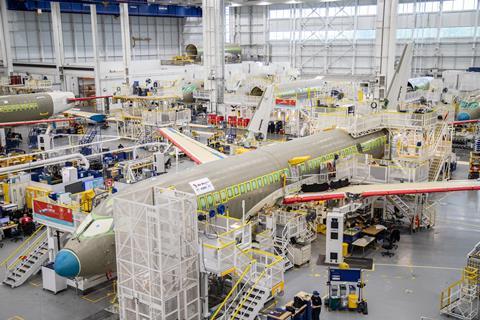
As part of the merger agreement, Spirit is selling certain of its assets to Airbus, notably A220 wing and mid-fuselage activities in Belfast, Northern Ireland and A350 centre fuselage production in Kinston, North Carolina.
Boeing, however, will retain the remainder of the work at Belfast, including the manufacture of structures for Bombardier business jets and nacelle inlets for Rolls-Royce Trent-family engines powering Airbus widebody jets.
The CMA says fears that Boeing could harm its rival’s competitiveness, either through restricting the supply of parts “or by increasing the price or worsening the quality of the input”, were unfounded, given the sale of the part of the business to Airbus.
Even though Boeing will still produce certain components for Airbus after the deal closes, neither airframer objected to this situation, the CMA says.
“The parties submitted that any work undertaken would be short-term, and/or low volume and relate to inputs of low value,” it says.
Airbus also flagged no concerns related to the supply of nacelle components to Rolls-Royce, the document adds.
The CMA also saw no issues in the defence segment. It says Spirit has not supplied aerostructures to any non-Boeing aircraft sold to the UK over the last five years, while the duration of development programmes is such that “switching aerostructure supplier or self-supplying would be achievable in that longer timeframe”.
Additionally, the UK Ministry of Defence raised no objections to the merger, the document says.
Lastly, the CMA analysed fears, raised by “some third parties”, that the merged business would “focus on Boeing workstreams and de-prioritise aerostructure and aftermarket workstreams” where Boeing has no end product, such as business jets.
“However, the CMA considers that the merged entity would not have the incentive to de-prioritise workstreams in areas where Boeing is not active as this would reduce the revenue generated from the assets used by Spirit to supply customers in these areas,” the CMA concludes.
Based on the latest timelines, the acquisition by Boeing, and asset sale to Airbus, are due to complete in the fourth quarter.