
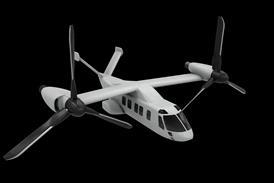












Vertical Aerospace is confident that it will wrap up the crucial final stage of its VX4 flight-testing – the piloted transition – by the end of this year.
The aircraft has already undertaken vertical flight, flying at up to 30kt, and conventional wingborne flight at speeds down to 70kt – just above stall.
“We’re only proving out what happens in this period between 30kt and 70kt when you’re flying on the wing,” said chief executive Stuart Simpson, speaking during a first-half briefing on 5 August. “That’s the bit of data we’re gathering.”
He says the company has “done everything” on the flight-test profile except the 20-30s period on the transition and the deceleration to landing, adding that the full transition testing is “absolutely on track” for the fourth quarter of this year.
“What we have is a huge truck with a big pylon on it, that’s driving up and down a runway at high speed, with our tilt actuators on the front covered in sensors,” he states.
Data from the vehicle tests enable the company to verify its models and support regulatory assessment.
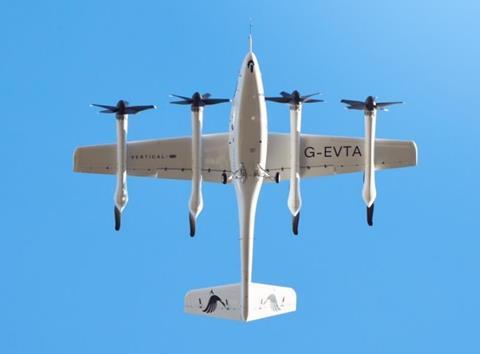
Achieving full piloted transition, says Simpson, will be a “huge unlock” because it will have “proved the concept of our aircraft”.
“We’ve done everything with it then,” he says. “We’re literally then into the shrink-wrap and beautification of the product.”
Vertical Aerospace is building a third and final prototype, set to fly before the end of this year, and has initiated manufacture of its first certification aircraft which will be ready for testing around December 2026.
The third prototype, an exact copy of the second, will double the flight-test capacity for the electric aircraft while also serving, next year, as the platform for a hybrid-powered version of the VX4.
Vertical Aerospace has been co-operating closely with the UK Civil Aviation Authority and is aiming to secure expanded approvals which will include flight privileges allowing the company to issue its own flight permits, removing the individual oversight so far needed for each phase.
The firm has also unveiled a partnership with Spanish-based specialist Aciturri, covering the VX4’s primary aerostructures – including fuselage, wing, empennage and pylons – complementing its agreement with Honeywell for flight-control systems.
Simpson says other elements of the supply chain will be “locked in” to produce the first certification aircraft.
This will be the first VX4 that will allow people to “really be able to see how this looks”, he states, adding: “We’ve initiated production of the [certification] aircraft, with long-range parts purchasing, continuing strong momentum with partners.”