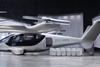














Electric air taxi developer Eve is preparing for first flight of its prototype aircraft and has revealed details about a pre-flight test campaign that involves using an iron bird test rig to validate the performance and integration of aircraft systems.
The Florida-based company has also tapped majority-owner Embraer to supply landing gears for the production-conforming variant of Eve’s in-development four-passenger electric vertical take-off and landing (eVTOL) aircraft.
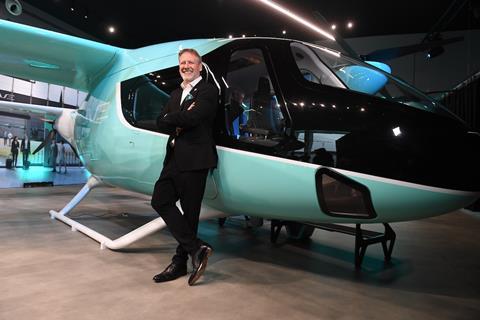
“We are in the final stages of testing our engineering prototype before the flight campaign starts,” Eve chief executive Johann Bordais said on 4 November during the company’s third-quarter earnings call.
Eve aims for the engineering prototype to get airborne for the first time “by the end of this year or early next year”, and to achieve certification and service entry in 2027, Bordais adds.
In August, Eve said it had tapped Vermont-based Beta Technologies to supply the engineering prototype’s electric motors.
“We are running the last set of tests to ensure the electrical power units were properly integrated with the inverters, battery and other system and subsystems. Therefore we are confident in starting soon our flight campaign,” Bordais says.
Though Eve intends for the production variant of its eVTOL to be flown by an onboard pilot, the company plans for its prototype to be flown initially by a grounded-based pilot in a “remote pilot station”.
Ahead of first flight, Eve has been using the iron bird rig to evaluate the aircraft’s systems and ensure proper integration.
“The iron bird is a deconstructed eVTOL in which we integrate all the actual components… into a physical system to ensure that all systems work together properly,” says Bordais.
“For instance, the joystick is connected to actuators and motors in another adjacent room, and they react physically to all pilot commands. All of these are connected to the avionics and the flight-control computers.”
Eve intends to have its aircraft first certificated by Brazilian aviation regulator ANAC and then to seek validations of the certification by other authorities.
“We continue talks with ANAC… to detail the certification plans. We expect it to be published by the end of the year, to begin certification tests,” says Bordais.
On 4 November, Eve said it reached an agreement to test its aircraft in Bahrain and to support development of an air taxi industry in that country.
“The agreement also calls for Eve to possibly conduct test flights in the region in 2027,” Bordais adds.
Eve previously released digital renderings showing its aircraft with landing skids.
But on 4 November the company said it selected Embraer to provide wheel-based landing gears for its production-conforming aircraft.
“The wheels on our eVTOL will be used for taxiing and repositioning the aircraft. This means greater energy and efficiency,” Bordais says.
Eve lost $47 million in the third quarter of 2025, reflecting additional research and development spending.
It ended October with $412 million in cash, cash equivalents and financial investments – enough “to fund our operations and R&D expenses through 2027”, says chief financial officer Eduardo Cuoto.