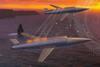















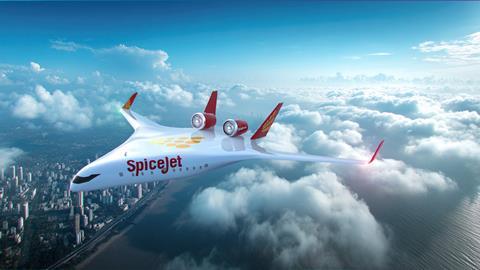
Indian low-cost carrier SpiceJet has disclosed a tentative order for 100 units of blended-wing body (BWB) aircraft developer Natlius’ conceptual Horizon jet.
The conditional purchase agreement hinges on Horizon clearing certification with relevant civil aviation authorities, the companies said on 17 December.
Natilus is establishing a new subsidiary, Natilus India, to support in-country operations, with headquarters in Mumbai. The company says it is working to certify Horizon with India’s Directorate General of Civil Aviation, as well as the US Federal Aviation Administration.
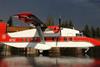
For Natilus, the partnership with SpiceJet represents new territory. The San Diego-based firm has secured similar conditional deals for its smaller cargo variant, Kona, with freight carriers Ameriflight and Canada’s Nolinor.
But SpiceJet’s tentative order is the first strong signal of interest from a passenger airline in the Horizon concept.
Aleksey Matyushev, founder and chief executive of Natilus, tells FlightGlobal that the start-up believes Horizon will have broad appeal among global low-cost carriers interested in the efficiency benefits of the BWB design.
”I think this announcement [with SpiceJet] will help spearhead a couple more conversations that we’ve had domestically here in the United States as well as internationally,” he says. “I’m getting excited about it, but I think there’s a huge opportunity not only in the tier one [airlines], but with low-cost carriers as well.”
Natilus believes in the future of India’s airline industry, with Matyushev noting that it is already one of the largest markets in the world and is “growing quickly”.
But securing similar deals with North American carriers remains a high priority.
“We have investors and our supply chain is here in the United States,” he says. “Of course, we want domestic United States airlines. We want one of the Big Three to be able to place an order with us. North America is a very focused market for us.”
Los Angeles-based competitor JetZero, which is developing a different BWB design, secured a “conditional” order for up to 200 jets from United Airlines earlier this year. It is also partnered with Delta Air Lines to explore potential cabin configurations.
Natilus positionins Horizon, which is designed to seat up to 240 passengers in a high-density configuration, in the large narrowbody market, competing with the Airbus A320neo family and the Boeing 737 Max family.
The start-up says Horizon will have a range similar to that of a 737 Max 8, but with radically reduced fuel burn thanks to the BWB design generating lift across the entire airframe.
There are sceptics of the BWB design’s near-term viability. Asked in October about the possibility of BWB manufacturers introducing products to compete against the Airbus-Boeing duopoly, LATAM Airlines chief executive Roberto Alvo told Airline Business that he does not believe radically new airframe technologies will impact the market for the next “10 or 15 years”.
Airbus CEO Guillaume Faury said in September that the BWB concept is better suited for widebody-sized jets, insisting that the follow-up to the A320neo family will stick with the tube-and-wing design.
Matyushev believes that the commercial market of the next 10-15 years will desperately need more aircraft production, regardless of body type.
“I think one of the biggest challenges is maybe not focused so much on technology, but just manufacturing capacity,” he says. “Just getting airframes out there and delivered is crucially important.
”There’s so many airplanes that need to be built over the next 20 years – 40,000 brand-new narrowbodies, and there is a 15,000 [aircraft] manufacturing capacity gap,” Matyushev adds. “We just need more players to do it.”
Though he does not share specifics, Matyushev says Natilus is progressing toward flying a sub-scale BWB prototype in coming months.
The company is also still working to identify a site for a US manufacturing facility – likely in an industrial state east of the Rocky Mountains, Matyushev says. Natilus hopes to decide on a factory location within the next 12 months.
This story has been edited to reflect that Natilus has a conditional deal with Ameriflight, rather than Amerijet.