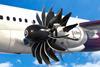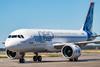
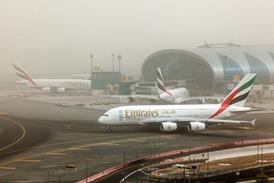













Pratt & Whitney continues to progress the certification and roll-out of a series of upgrades for its geared turbofan (GTF) engine family to boost durability in challenging environments like the Middle East.
Although much of the focus on the GTF has been the ongoing recall due to a defect with the powder metal used in its manufacture, operators have also raised concerns about its time-on-wing performance.

But the engine maker is increasingly confident that the durability issues will soon be a thing of the past.
On the PW1100G for the A320neo, P&W has begun introducing redesigned components as part of its D.1 build standard for the powerplant, says commercial engines president Rick Deurloo.
These “near-term” upgrades include a redesign to one of the bearing compartments, new turbine hardware and a change in how the combustor panels are manufactured, moving from laser to water-drilling.
“It may sound simple, but the impact is incredible. We have got it flying today with IndiGo and we are seeing really good results,” he said, speaking to media ahead of the Dubai air show.
Certification for the improvements was gained in the first quarter of this year and they are now being introduced into the MRO system; incorporation into new-build engines will take place from 2026.
Meanwhile, P&W is working to certificate its Hot Section Plus (HS+) option on the same engine, which introduces 35 new components originally developed for the new-build GTF Advantage.
Operators should see a significant time-on-wing improvement from the package, which will be available from early next year following the completion of ongoing flight testing.
Although acknowledging there is a “pricing premium associated” with the HS+ upgrade, Deurloo believes it will still prove popular, noting the improvement in residual value that will be achieved.
“I don’t know why any airline would not want to put it in there. What will pace incorporation will be the industrial ramp.”
Meanwhile, the GTF Advantage itself continues to progress towards service entry following its certification earlier this year by US and European regulators.
Aircraft-level certification should follow in the first half of 2026 “and we will start delivering the first engines to Airbus in the coming months”.
Production cut-over to the Advantage should take place over around 18 to 24 months “and by the end of 2027 will switch to 100%” of these, leading to delivery to an airline customer during the first half of 2028.
P&W says the GTF Advantage will double time-on-wing in challenging environments to around two years, says Deurloo, or four to five years in more benign conditions. In addition, take-off thrust increases by 4-8%, depending on the operating environment.
Additionally, P&W continues to introduce durability improvements on the PW1500G for the A220 and Embraer E2-powering PW1900G.
A similar suite of hot-section improvements is being incorporated into both engines with a further package derived from those on the GTF Advantage currently in the design and testing phase.
Deurloo says once these enhancements, plus additional investments in its MRO network, will “clear the AOG situation” – or aircraft on ground – for those powerplants by the end of 2026.
“You will see this in a much better place by the end of next year,” he adds.