











Pratt & Whitney (P&W) now aims to deliver 8-10% more PW1000 geared turbofans (GTFs) this year than last, though it must ramp output in the final three months of the year to hit that goal.
Chris Calio, chief executive of P&W parent RTX, disclosed the production estimate on 21 October, after having in January predicted P&W’s 2025 large-engine deliveries would be “similar” to the 14% year-on-year bump achieved in 2024.
His comments came as RTX reported third-quarter financial results and upped its 2025 financial guidance, citing strong demand for engines and other products such as aftermarket services.
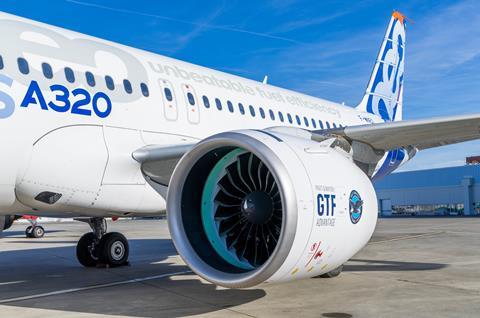
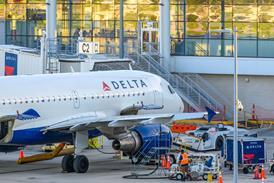
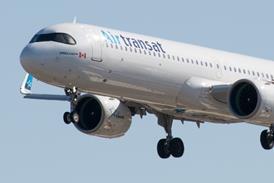
Connecticut-based P&W delivered 266 large commercial aircraft engines during the third quarter, up 6% year on year. It delivered 743 of the engines in the first nine months of 2025, a 3% year-on-year bump. P&W’s large commercial engines primarily include the best-selling GTFs that power Airbus A220s, A320neo-family jets and Embraer E-Jet E2s.
“I think we are going to end up in the high single-digit growth [range]… the 8-10% range,” Calio says when asked how many GTFs P&W will deliver this year.
The company handed over 996 large commercial engines last year. An 8-10% bump from that figure comes to 1,076-1,096 engines.
P&W has been working to increase production amid lingering parts and labour shortages – factors that have also beset competitor GE Aerospace. P&W has also been navigating a disruptive a multi-year GTF recall that has forced airlines to ground hundreds of jets for months on end.
The recall has prompted demand for spare engines at the same time prime customer Airbus needs more GTFs to accommodate its production goals, leaving P&W juggling competing priorities.
“We’re going to continue to work very closely with Airbus to make sure that they have what they need down the stretch of the year, [while] also continuing to balance the allocation of material,” says Calio. “We’ve got to continue to support the fleet.”
He notes P&W has increased production more than 50% since 2019.
P&W has also been ramping its maintenance capabilities to address the GTF recall.
“We continue to work with our supply chain partners to increase the flow of critical value stream material, to ramp MRO output,” Calio says. “In Q3, we saw another quarter of solid progress, with growth in isothermal forgings up 16%, and structural castings up 29%, year over year.”
P&W’s third-quarter sales surged 16% year on year to $8.4 billion, driving the division to a $751 million operating profit, up 35%.
RTX’s Collins Aerospace division, meanwhile, turned a $1.3 billion third-quarter operating profit, up 19% year on year, with sales up 8% to $7.6 billion.
Those figures and ongoing strong demand prompted RTX to raise its guidance.
It now expects P&W will achieve a $350-400 million 2025 operating profit in 2025, up from a prior $200-275 million estimate. Collins is on track to post a $325-375 million 2025 operating profit, compared to a previous $275-350 million estimate.