














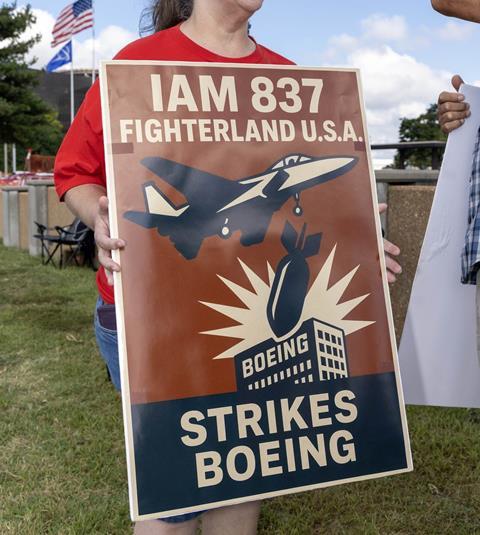
Striking machinists at Boeing’s fighter aircraft unit have rejected another contract offer from the aerospace giant, as the labour stoppage prepares to enter its sixth week.
Members of IAM Union (International Association of Machinists and Aerospace Workers) District 837 held a referendum on 12 September to consider the latest proposal from Boeing, which included a 45% pay increase over five years.
Boeing and IAM negotiators tentatively agreed to that framework on 10 September, pending ratification by union members.
The latest contract offer significantly pushed up pay incentives compared to Boeing’s initial proposal, which included a 25% pay hike over five years.
The sticking point appears to be the value of a signing bonus Boeing will pay to each union member when a contract is ratified. The company had originally proposed $5,000 per worker, but revoked the bonus entirely after the 3,200 machinists rejected that deal in late July.
While Boeing had earlier said it would not reinstate the bonus, strong objections from the striking machinists led the company to return the bonus offer in its latest contract offer – although the dollar amount was not specified.
“Boeing’s modified offer did not include a sufficient signing bonus relative to what other Boeing workers have received, or a raise in 401(k) benefits,” IAM says.
The union’s rejection of the deal – notably the second time members have overruled their negotiating team – means the six-week strike will drag on.
Boeing says it is moving forward with plans to hire permanent replacements for the machinists. The company has already reassigned non-union staff with similar skills to perform those duties throughout the strike.
“We’re disappointed our employees have rejected a five-year offer, including 45% average wage growth,” says Dan Gillian, Boeing’s general manager of air dominance.
“We’ve made clear the overall economic framework of our offer will not change, but we have consistently adjusted the offer based on employee and union feedback to better address their concerns,” he adds. “In the meantime, no further talks are scheduled.”
Following the results of the vote, the IAM’s general vice-president for the Midwestern USA region Sam Cicinelli said the machinists will “not be brushed aside with small adjustments”.
Boeing has repeatedly accused the union of not providing a clear financial target for negotiations.
The IAM says the fighter workers want changes to pay and benefits comparable to what Boeing commercial aircraft machinists received after a 53-day strike in 2024 that saw more than 30,000 employees walk off the job.
Boeing has pushed back on this, noting the difference in cost of living between the Seattle-area where it assembles many passenger jets and the fighter assembly complex in St. Louis, Missouri.
The airframer has thus far avoided fully shuttering its fighter aircraft production lines, which assemble the F/A-18E/F and F-15EX fighters, the MQ-25 autonomous refueller and T-7A trainer jet.
The company has also been able to maintain output on its precision munition lines.