











The US government has awarded Lockheed Martin a contract to urgently provide its Legion infrared search and track (IRST) pod for Taiwan.
The “undefinitised” Foreign Military Sales contract is valued at $329 million and covers podded sensor systems for the Lockheed F-16V fighter, of which Taiwan is a major operator, according to a Department of War contract announcement.
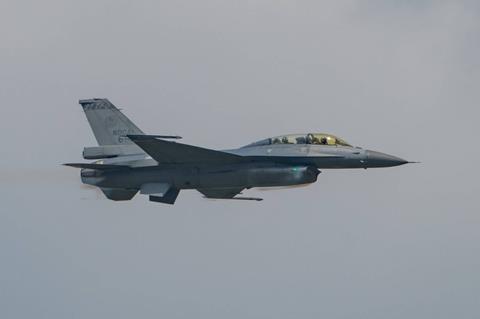
Specifically, it provides 55 Legion IRST pods and related equipment for an initial amount of $158 million, which Taiwan requires under “an urgent operational need”.
The number of Legion pods is sufficient to equip nearly half of Taiwan’s in-service F-16Vs. At the Singapore air show in March 2024, AIDC told FlightGlobal that it had completed a programme to upgrade 139 jets to the F-16V standard in 2023. Taiwan also has 66 F-16 Block 70s on order, with delivery of these jets likely to commence in 2026.
The Legion IRST capability is likely to boost the ability of Taiwanese fighters to track Chinese combat aircraft, namely low observable types such as the Chengdu J-20 and Shenyang J-35/35A fighters.
The Legion Pod has a dedicated, high-speed datalink that allows multiple aircraft to share infrared data in real-time, enabling a group of fighters to triangulate and range stealth targets without activating their own radars.
The undefinitised contract terms bypass the standard multi-year procurement process, allowing Lockheed to start production immediately with final terms to be negotiated later.
How the balance of the $329 million will be spent is not clear, but Taiwan already uses Lockheed’s Sniper pod, which is optimised for ground attack, and LANTIRN pods, which support low altitude navigation.
The timing of the announcement is notable because it follows unprecedented Chinese military manoeuvers around Taiwan in late 2025 with both aircraft and ships.
Spanning 29 and 30 December, Beijing’s ‘Justice Mission 2025’ drills saw a record 130 aircraft and over 25 naval and coast guard vessels saturate the Taiwan Strait in a 48h simulated blockade that affected regional flight paths and maritime trade.
Although China regularly probes Taiwanese defences, Justice Mission 2025 was ostensibly in response to the US government’s clearing of $11.1 billion in possible defence sales to Taiwan in mid-December.
The potential orders are largely focused on ground-based systems but related directly to aviation capabilities, the possible sale of Anduril loitering munitions and spare parts for Taiwan’s Bell AH-1W attack helicopters.