














The US Air Force (USAF) has partnered with California’s Stanford University to evaluate the potential of artificial intelligence in reducing the cockpit workload of its pilots.
The so-called AI “copilot” is meant to reduce the cognitive stress aviators endure during periods of intense mental activity, such as in-flight emergencies or diagnosing unknown problems.
The Silicon Valley university partnered with the USAF’s Test Pilot School to evaluate the potential of the new cockpit software, which was developed by Stanford’s Intelligent Systems Laboratory.
An overview of the project first appeared in the Stanford Report, which was shared by the US Air Force Test Center in January.
“Pilots train intensely for emergencies, but accident databases show that many mishaps stem from human error. If we can get the right information to the pilot as quickly as possible, we can significantly improve safety,” says Mykel Kochenderfer, an assistant professor of aeronautics at Stanford and leader of the Intelligent Systems lab.
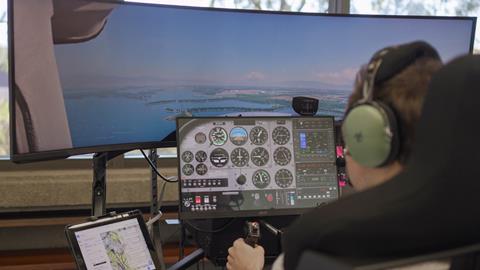
Housed on a standard Apple iPad, the AI copilot functions like an advanced digital search function to instantly comb through technical manuals and contingency procedures to help aviators correctly assess and respond to in-flight anomalies.
“Normally, they’d flip through checklists and manuals to diagnose the issue, but the assistant can scan those and return guidance within seconds,” says Stanford doctoral candidate Marc Schlichting.
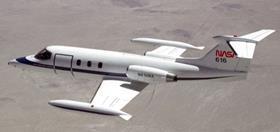
To test the digital copilot’s abilities, researchers and the Test Pilot School incorporated the AI into a flight simulator and the actual cockpit of a Learjet 25 business jet.
The simulator, located in Stanford’s Department of Aeronautics and Astronautics, was used to assess the copilot software on rare or complex scenarios, including cascading failures, that the research team describes as too dangerous to attempt in flight.
Separately, a cohort of 24 air force test pilot students then flew a Learjet 25 through safety evaluation scenarios both with and without the AI assistant, with the goal of measuring how the software impacted an aviator’s workload management, decision making and ability to diagnose ambiguous system failures.
The results of those trials are still being analysed, with Stanford researchers planning to detail them in an academic paper.
Kochenderfer says the data will help the team continue to refine the cockpit assistant software specifically and more broadly further the potential uses of AI tools for safety-critical environments.
He says such systems will ultimately “make flying safer for everyone”.
Major John Alora, director of operations at the jointly run [Department of the Air Force]-Stanford AI Studio, says he expects the AI copilot will eventually be deployed beyond military cockpits.
“What’s really exciting about this technology is that it has applications for both long-duration military missions and enhancing safety and workload management in commercial aviation,” he notes.
The air force is funding research and testing by a number of private companies that are also exploring the potential for AI and automation software to reduce the workload of pilots and crew.
Boston-based Merlin Labs is developing in-flight autonomy solutions for frontline US military aircraft, including the Boeing KC-135 tanker and Lockheed Martin M/C-130J, with aerial testing already underway.
Similar to the Stanford project, Merlin’s goal is to reduce workload and use technology to better assist pilots in handing the complex and unexpected aspects of flying.
The company has a contract with US Special Operations Command to demonstrate reduced crew operations for the MC-130J, and is also participating in Northrop Grumman’s Beacon autonomous flight project.
A number of other firms, including Reliable Robotics and Xwing, are developing advanced autopilot systems with the support of the air force using the latest autonomous flight technology.
In August 2025, Reliable Robotics signed a $174 million deal with the USAF to supply Reliable Autonomy System (RAS) onboard a Cessna 208B Caravan aircraft for testing. That system offers full automation throughout all phases of flight.
Reliable Robotics already demonstrated the RAS capabilities in flight for the air force during exercises in 2024.