














Several key US Navy aviation programmes face continued challenges, according to the annual report by the Office of the Director, Operational Test and Evaluation (DOT&E).
The report covers testing of key weapons systems across the US military in 2025.
It notes that the US Navy aims to see the Bell Boeing CMV-22B tiltrotor achieve full operational capability in fiscal year 2026, which ends on 30 September.
Nonetheless, DOT&E will retain oversight of the programme given pending changes to the aircraft’s fuel cell, communications equipment, and gear boxes.
Based on the V-22, the CMV-22B is designed to replace the Northrop Grumman C-2 Greyhound in the carrier onboard delivery mission, with detachments of three aircraft supporting a deployed aircraft carrier.
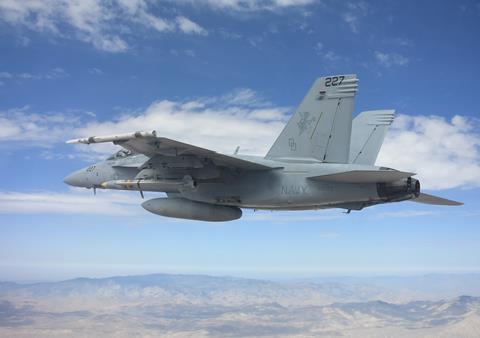
The report indicates that a new infrared search and track (IRST) sensor for the F/A-18E/F Super Hornet has suffered reliability problems during operational testing.
“IRST Block II demonstrated the ability to detect operationally representative targets at tactically relevant ranges,” says the DOT&E.
“However, IOT&E [Initial Operational Test and Evaluation] revealed some problems that limit the effectiveness of IRST Block II for air-to-air combat.”
The sensor is mounted in the forward section of the centre-mounted fuel tank. It offers a passive targeting capability in contested electromagnetic environments where radar use may be limited.
The DOT&E also indicates that the Raytheon AN/ALQ-249 Next Generation Jammer Mid-Band (NGJ-MB) is not yet ready for operational service. The system is designed to replace the AN/ALQ-99 carried by the EA-18G Growler electronic warfare aircraft.
“Although challenges still exist, the NGJ-MB performed as well as, and in some cases better than, the legacy AN/ALQ-99 against the threats tested on the open-air test ranges,” says the DOT&E report.
“The NGJ-MB is currently not suitable for supporting operational missions, primarily due to lingering reliability concerns, but is continuing to develop into its potential.”
The report also highlights delays with the Northrop Grumman AGM-88G Advanced Anti-Radiation Guided Missile – Extended Range (AARGM-ER), with tests targeted for fiscal year 2025 pushed back while issues discovered during testing are addressed.
DOT&E does not expect to conduct IOT&E events until after the missile reaches initial operational capability, currently planned for early in fiscal year 2027.
In three FY2025 AARGM-ER tests against simulated air defences at California’s China Lake range, only one was successful.
The other two suffered performance discrepancies, including one event in which range safety terminated the weapon after release.
The report also notes that AARGM-ER’s advanced capabilities and extended range push beyond the infrastructure of most test facilities, requiring coordination across multiple ranges to conduct meaningful trials.