










A new analysis argues that the West could meaningfully accelerate Russia’s decline as a producer of modern fighter aircraft.

A report by the Royal United Services Institute (RUSI) finds that the supply chain behind fighters such as the Sukhoi Su-35 and Su-57 contains a range of little-understood vulnerabilities that can be exploited through targeted sanctions.

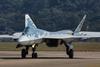
Sukhoi Su-57

Source: Rostec

Russia has high hopes for Su-57 exports

The report lands as Russian state arms conglomerate Rostec prepares a major sales push at the Dubai air show, where the Su-57E export variant is set to appear in the show’s flying display.  Rostec will also promote the Yakovlev Yak-130M advanced jet trainer and the Kamov Ka-52 attack helicopter. 

Rostec’s Dubai foray comes even as Russia continues to apply heavy military pressure, including attacks on civilians and infrastructure, in its invasion of Ukraine.

“Expanding the sanctions regime against the second and third tiers of the Sukhoi supply chain could help to disrupt production of Russian aircraft today and highlight to Russia’s potential export customers the risks in becoming dependent on Russia for the maintenance and provision of aircraft in the future,” the report states.

It adds that sanctions, combined with Ukraine’s expanding deep-strike campaign, could further hinder Russia’s ability to replace damaged equipment.

The study details several areas where critical Sukhoi components depend on Western equipment for calibration, testing and high-precision machining. Although direct sales to Russian companies are restricted, these tools are still being procured through third countries, notably China.

“Despite the rise of Russia’s own production of electronic components and specialised machinery to replace imported ones, key manufacturers within the Sukhoi production chain still heavily rely on critical foreign components and equipment, acquired mostly before 2022,” the authors write.

Import substitution, the report notes, can alleviate some pressures, but shifting to domestic alternatives often disrupts supply chains and triggers lengthy certification processes.

The authors also highlight Russia’s ageing aerospace engineering workforce, warning that significantly higher pay abroad continues to draw younger specialists out of the country.

These structural weaknesses come as many Russian aircraft serving with international operators approach obsolescence. This creates an opening for Chinese fighters, particularly in Africa.

Western governments, the report argues, must offer credible alternatives.

“It is necessary for NATO members to consider their offer to compete with Russia and, more importantly, China in those countries that must soon look to replace ageing combat air fleets,” it says.

It contends that western fighters can struggle on grounds of cost, maintenance, and political constraints.