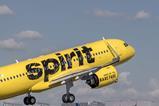










The extent of Spirit Airlines’ fleet-reduction plan is becoming clear as the beleaguered ultra-low-cost carrier (ULCC) seeks to reject the leases of a further 87 Airbus jets as part of the company’s Chapter 11 bankruptcy proceedings.
Spirit awaits a hearing before judge Sean Lane of the US Bankruptcy Court for the Southern District of New York, scheduled for 16 October, to determine whether the ULCC will be relieved of lease obligations for dozens of aircraft – on top of the 27 aircraft leases that Spirit has agreed to reject through a new arrangement with Irish lessor AerCap.
In total, the ULCC is seeking to return at least 114 jets to lessors – more than half of its current fleet.
Spirit reported operating a fleet of 215 Airbus aircraft on 30 June.
Cirium fleets data show that Spirit currently has 149 jets in service, with another 65 listed as in storage, meaning they have been parked for more than 30 days. The data are a snapshot of the rapid scale-down underway across Spirit’s fleet.
Spirit’s latest and most significant fleet-reduction measure yet was first reported by Airline Geeks.
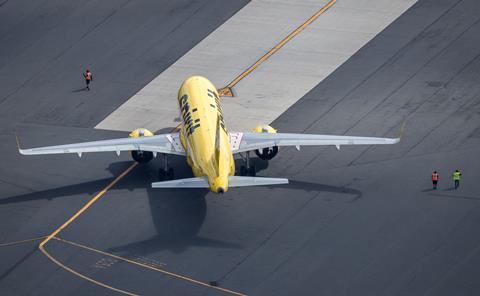
Spirit has identified lease obligations as a major impediment toward its goal of reviving profitable passenger-carrying operations, and has earmarked 87 aircraft – a mix of Airbus A320neos, A321neos and older A320s – as among those it wants to hand back to lessors.
Spirit might not be done trimming its fleet, either. The company appears to anticipate removing more aircraft, adding that it is “continuing to consider methods for the return and surrender of certain aircraft and engines in order to reach an optimal fleet size”.
The ULCC does not divulge what it considers an “optimal” fleet size.
”Spirit will continue to analyse its fleets and, as part of this ongoing analysis, Spirit may determine that it is appropriate for additional aircraft and related equipment to be retired in the future,” it says.
Spirit describes the fleet-reduction moves as part of its “revised business plan… to achieve a viable and profitable business platform”.
”As a key component of that plan and the Chapter 11 process, Spirit has identified cost-savings to be achieved through a significant reduction in its fleet by eliminating aircraft other related equipment that currently or not, or soon will not be, used to generate revenue in Spirit’s business,” the ULCC says.
“This reduction and rationalisation of Spirit’s fleet will create a surplus of aircraft and other related equipment owned and leased by Spirit,” it says.
Spirit is pursuing a ”orderly, efficient process” for returning jets to lessors. It requests that the court order lessors to retrieve aircraft with 15 days of “the relevant effective date” or assume responsibility for the costs of aircraft storage.
The Florida-based company also requests the timely filing of proofs of claim arising from rejected contracts, and has hired international law firm Debevoise & Plimpton to act as fleet counsel in potential disputes with lessors.
Spirit says an unspecified number of aircraft have already been retired from its fleet. It has been struggling for years with double-digit numbers of A320neo-family aircraft grounded due to Pratt & Whitney’s recall of the PW1000G engines that power its latest-generation jets.
Dozens of Spirit’s grounded jets are awaiting or undergoing engine maintenance, while others are being removed from service entirely.
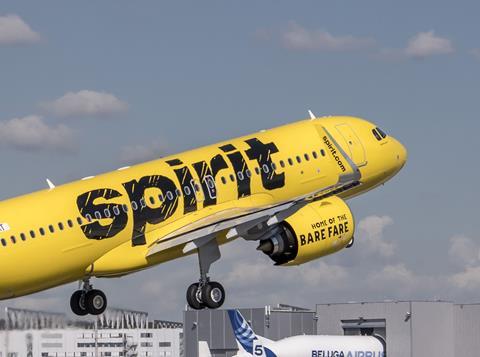
Some airline analysts had warned for years that Spirit had taken on too many narrowbody jets too quickly, with mounting lease obligations amounting to albatross contracts.
While reflective of the ULCC’s individual financial struggles, Spirit’s fleet-reduction decisions also highlight limitations of the sale-leaseback deals used heavily by Spirit and fellow ULCC Frontier Airlines – and to a lesser extent by Southwest Airlines. Sale-leaseback deals provide immediate cash and operational control of aircraft but typically come with heavy long-term costs.
American Airlines and United Airlines have also made use of such transactions in recent years.
Most of Spirit’ fleet is currently composed of leased aircraft, though the percentage of its owned fleet would rise significantly if it successfull returns more than 100 aircraft to lessors.
Last week, Spirit said it has made “significant progress” on restructuring its business, recently securing from debtors a $475 million financing facility to support ongoing airline operations, with about $200 million expected to be available immediately upon court approval.
The ULCC plans to emerge from Chapter 11 in the fourth quarter with radically less debt, a smaller fleet and a more focused network.
Meanwhile, Spirit’s reduced presence in certain US markets is creating new opportunities for smaller low-cost players Allegiant Air, Avelo Airlines and Breeze Airways.