












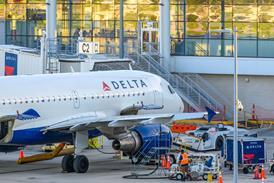
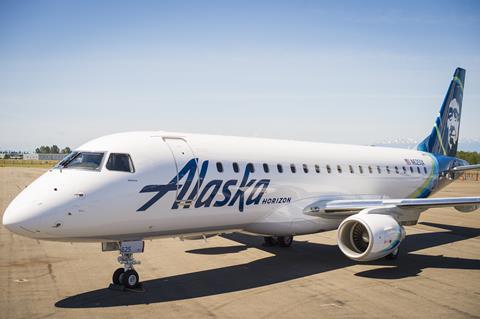
Alaska Air Group subsidiary Horizon Air needs more time to comply with the Federal Aviation Administration’s new secondary cockpit barrier rule, citing complications related to cabin configurations of its Embraer 175 regional jets.
The Portland-based carrier in a 13 February letter asked the FAA for an extra 12 months to comply with the rule, which requires new aircraft be equipped with “installed physical secondary barriers”.
Those devices are intended to bolster cockpit security and are part of a yearslong regulatory and legislative effort in response to the 11 September 2001 terrorist attacks.
The FAA initially required that the barriers be installed on large passenger aircraft manufactured after 25 August 2025.
But the regulator later agreed to push back the deadline by one year, bending to a request from trade groups Airlines for America and Regional Airline Association. Those groups said the barriers were only then being certificated, and that they therefore needed more time to train crews to operate them.
The rule now takes effect in August 2026.
But Horizon, which operates a large E175 fleet for Alaska, is seeking an additional 12 months to comply.
“Embraer notified Horizon Air in December 2025 that the certified E175 [barriers] will not be usable on Horizon Air aircraft due to the configuration of the Horizon Air galley,” says the airline’s letter to the FAA, posted to the US government’s regulatory repository on 17 February. “The anticipated certification timeline leaves the possibility of insufficient time for Horizon Air to develop training, obtain training programme approval and complete crew training before the deadline.”
Embraer already developed and received certification for an E175 secondary barrier, the company notes in a 2 December 2025 memo to Horizon.
But the aircraft maker specifically designed that barrier for E175 cabins fitted with “a wardrobe in the forward service area”, which provides “the necessary [forward-facing] surface required to install a stowage box for the barrier when it is not deployed”, says the letter, which Horizon filed with its exemption request.
“Horizon Air’s cabin differs from the certified configuration, as it is equipped with a galley instead of a wardrobe,” Embraer adds. “This galley lacks the [forward-facing] surface essential for the installation of the barrier’s stowage box.”
Embraer is now modifying the barrier to work with Horizon’s jets, saying it expects the revision will achieve regulatory approval in July.
Embraer expects, by September, to make the kit required to complete the retrofit available to Horizon, the letter says.
Neither Horizon nor Embraer immediately respond to requests for comment.