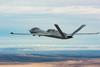



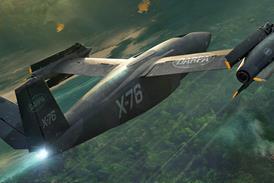














The Pentagon’s secretive technology incubator has been quietly making progress on a new prototype air vehicle capable of launching precision-guided missiles.
Sometimes referred to as a “missile truck”, the concept envisions an uncrewed platform that can be launched from a crewed aircraft and travel onward independently to deploy weapon systems, while the crewed aircraft remains at a safe standoff distance.
The US Defense Advanced Research Projects Agency (DARPA) has been developing the concept since 2021 under the LongShot programme. Uncrewed aircraft manufacturer General Atomics Aeronautical Systems was awarded a contract at the time to begin design work.
Five years later, those efforts have shown enough progress that DARPA has now designated the LongShot vehicle as the X-68A.
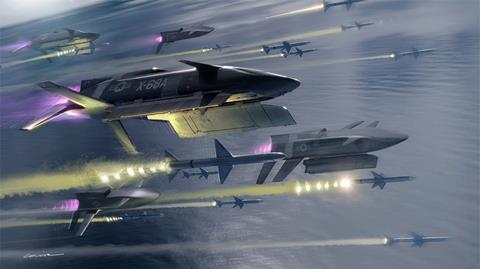
The agency announced the milestone on 17 February, noting General Atomics has completed a series of technical milestones on the pathway to flight testing, including full-scale windtunnel tests and successful trials of the vehicle’s parachute recovery and weapons-release systems.
“With the help of our partners, we’ve completed critical milestones necessary for the integrated flight test campaign, which will validate vehicle performance and lay the foundation for efficient follow-on development,” says LongShot programme manager Colonel John Casey.
DARPA says the X-68A will be compatible with both fighters and bombers. Transport aircraft will also be able to deploy the uncrewed system as a palletised munition.
The LongShot programme envisions a system that would fly ahead of friendly forces to engage enemy targets with its internally carried air-to-air missiles.
“This approach augments traditional fighter aircraft, enabling them to remain farther from the front lines, drastically increasing pilot safety while extending the overall force package reach and mission effectiveness,” DARPA says.
Ground and integration testing are currently underway on the X-68A, with a flight test campaign poised to launch as early as the end of 2026. That airworthiness campaign will see the X-68A deployed from a Boeing F-15 and subsequently launch its own onboard sub-munition.
A successful demonstration would allow DARPA to pass on the LongShot technology to the US military for consideration and potentially full-scale procurement – although such an outcome is not guaranteed for any DARPA programme.
C Mark Brinkley, the senior director of marketing and communications for General Atomics, confirms that flight testing on the X-68A will start later this year.
The company had previously set the goal of starting a LongShot flight test campaign in 2024.
Brinkley notes that General Atomics is gearing up for the start of X-68A flights at the same time it is conducting airworthiness trials on another experimental design – the YFQ-42A uncrewed fighter prototype for the US Air Force (USAF).
“Building one X-plane, much less two at the same time, is no small feat,” Brinkley says.
The YFQ-42A is competing against the YFQ-44A from Anduril Industries to become the USAF’s first autonomous fighter jet – officially known as a Collaborative Combat Aircraft.
The service has said it hopes to conclude flight trials and select a winner by the end of this year.