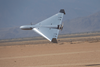

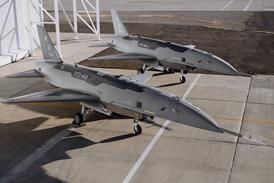
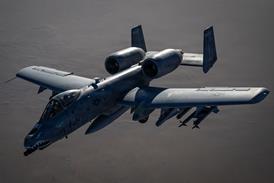














Korea Aerospace Industries (KAI) has successfully tested its Adaptable Aerial Platform (AAP) using the company’s artificial intelligence pilot.
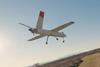
In a video at the Seoul ADEX show, KAI shows the turbojet-powered AAP prototype being launched from a catapult and traversing the sky around an airfield under its own autonomous guidance.
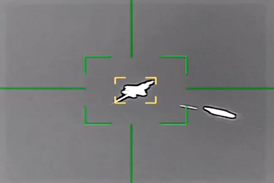
The system, dubbed “K-AI Pilot”, is autonomous, for example avoiding a section of airspace representing the threat envelope of a surface-to-air missile. The AAP also dives on a “target” after identifying it as an enemy vehicle and then pulling up in the last second – in a real engagement, a warhead-equipped AAP could attack the target.
The test work depicted in the video was completed within recent weeks. Next steps for the programme involve improving its performance and AI capabilities for more advanced simulated missions, including multiple AAPs operating together.
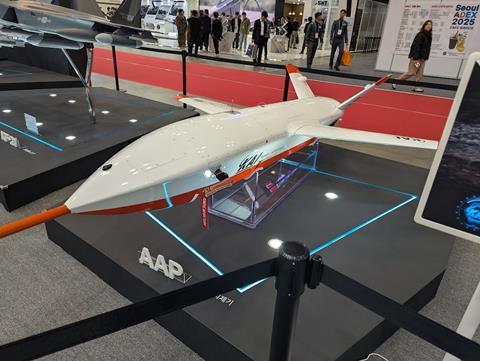
KAI is displaying the prototype used in the tests at its stand during the Seoul ADEX defence show. After the show the prototype will return to testing work.
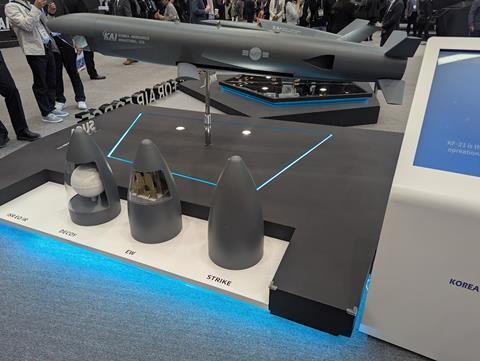
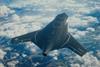
The AAP is envisaged as a ground-launched collaborative combat aircraft (CCA), but work on the programme supports a parallel effort to develop an air-launched CCA called SUCA, a model of which is also on display at the show.
The SUCA will be able to perform different missions using interchangeable nose sections. Nose modules depicted for SUCA include electro-optical/infrared, decoy, electronic warfare, and strike.
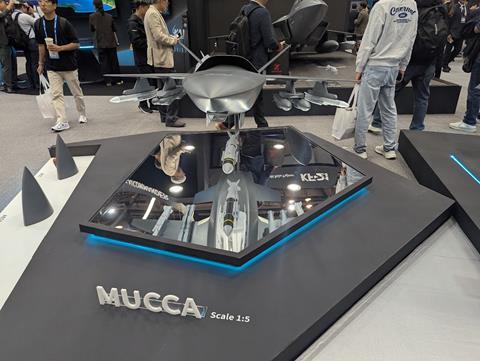
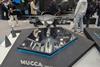
Alongside its SUCA, KAI is also showing a conceptual CCA called MUCCA that would be roughly the same size of its FA-50 light combat aircraft. A MUCCA model shows the aircraft with four wing hardpoints that can hold air-to-air missiles, ground attack munitions, or SUCA CCAs. In addition, the MUCCA has an internal weapons bay that can carry a single 907kg (2,000lb) bomb or other munitions.
As with the SUCA, the MUCCA features flexible nose options including infrared search and track, an active electronically scanned array radar, and an electro-optical targeting system.