

















US defence manufacturer Northrop Grumman says the company’s new jet-powered attack platform – called Lumberjack – is ready for service after just over a year of development.
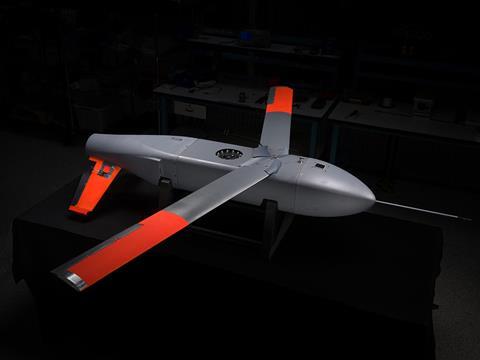
Lumberjack is a Group 3-sized vehicle that falls into the emerging category of systems straddling both the uncrewed aerial vehicle and precision munition categories. Such platforms have been dubbed “launched effects” by the US Army.
Each Lumberjack will weigh between 136-181kg (300-400lb) and offer a modular payload that can be either air- or ground-launched, according to a Northrop official who spoke with FlightGlobal. The range is expected to be roughly 200nm (370km), with variation depending upon method of deployment.
With a body length of roughly 1.8m (6ft), the system is similar in size to the low-cost GBU-39 Small Diameter Bomb glide munition – multiples of which can fit inside the internal weapons bays of a Lockheed Martin F-35 stealth fighter.
Northrop describes the new system as an ”attritable” UAS that offers loitering and beyond line-of-sight precision strike and electronic warfare capabilities at an affordable price.
“What we really wanted to do is provide the lowest cost-per-effect,” says Michael Bastin, Northrop’s Lumberjack programme director.
Northrop displayed the Lumberjack at the annual Association of the US Army conference in Washington, DC from 13-15 October.
“This is not a low-cost cruise missile,” Bastin adds. “There’s lots of people out there in the Group 3 making specifically low-cost cruise missiles. This is about having the longest range and the highest weight payload and lowest operational cost.”
Bastin says the Lumberjack’s modular centre bay will also allow customers to quickly adapt the munition for specific and emerging needs.
Notably, a Northrop digital fact sheet on the Lumberjack shows multiple examples being dropped from a Kratos XQ-58 Valkyrie autonomous jet, indicating the company believes the new weapon will likely be compatible with the uncrewed tactical fighters being developed by the US Air Force under the Collaborative Combat Aircraft programme.
Northrop is far from alone in pursuing such a capability. Competitors including Lockheed, Anduril Industries, MBDA and Kratos have all debuted various sizes of folding-wing munitions over the past two years.
The goal of the various offerings is to provide large amounts of precision firepower that can be produced at an affordable price and more rapidly than conventional guided missiles.
What is perhaps more interesting about Northrop’s Lumberjack is how quickly the company has brought the new system to market.
The company’s development period covered less than 14 months from Lumberjack conceptualisation to flight testing. Northrop is touting a new approach to weapons development as enabling the truncated timeline.
That process began with an emphasis on commercially available systems, including engines and computer processors.
Rather than handle the entire process in-house, Northrop partnered with AI software developer Palantir and aerospace manufacturing firm ESAero on the Lumberjack.
“We use these ‘non-traditionals’ to really help us with speed to market, affordability, and leveraging the commercial industry,” Bastin notes. “We have rapid software development capabilities from Palantir and we get scalable, predictable, flexible manufacturing at an affordable rate with ESAero.”
In practise, Bastin says the teaming allowed Northrop engineers to design new features or capabilities, which the company’s more nimble manufacturing partners would then turn “into a piece of hardware in a matter of days and weeks that we can test”.
This type of partnership approach, he adds, will also allow Northrop to more rapidly scale-up Lumberjack production.
“We see the demand signal from the government, from others that we need to be doing things more quickly,” Bastin says.
Thus far, flight trials have evaluated what Bastin describes as a “handful” of Lumberjack payloads, based on customer feedback.
Northrop plans to work with several potential customers to execute “more tailored flight testing” throughout 2026.