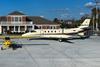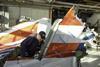












While investigators have yet to draw any conclusions about the Bombardier Challenger 600 crash in Bangor, the type – and its derivatives – have previously been the subject of scrutiny owing to the sensitivity of their wings to contamination.
The Challenger is a wide-cabin business jet, among the first aircraft designed with a supercritical wing intended to reduce drag in cruise.
This wing profile, with a relatively flat upper-surface camber, pushes the onset of shockwaves at high speed further aft and reduces drag.
But the supercritical wing’s characteristics also make it vulnerable to stalling, and a rapid loss of lift, as a result of leading-edge disturbance. The Challenger 600 is not equipped with leading-edge slats.
Several accidents in winter snow and icing conditions have been attributed to wing contamination, not just with the Challenger but also the CRJ100 and CRJ200 regional airliners which were derived from the business jet in order to capitalise on its wide cabin. Although originally a Bombardier product, the type certificates for CRJ-series are now held by MHIRJ.
In some cases – such as the fatal take-off accidents involving Challenger 600s at Birmingham in the UK in January 2002 and Montrose, Colorado, in November 2004 – UK and US investigators discovered that the aircraft had not been de-iced prior to departure.
China’s ministry of emergency management also determined that a China Eastern Yunnan CRJ200 stalled and crashed on take-off from Baotou airport, also in November 2004, owing to the “likely contaminant” of frost on the wings, with no-deicing performed beforehand.
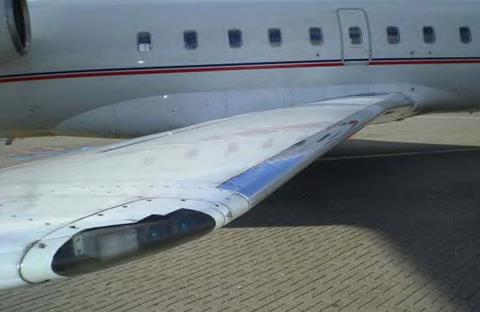
But other occurrences have shown that undergoing de-icing treatment is not alone a guarantee of safety.
The Russian inquiry into a US-registered Bombardier CRJ100 crash at Moscow Vnukovo in February 2007 found that the aircraft had been de-iced about 26min before take-off.
But it also stated that the weather conditions – including moderate to heavy snow – probably allowed the accumulation of ice while on the ground, despite the de-icing treatment. The crew was likely to have underestimated the weather, and assumed the de-icing offered a longer protection period than was actually the case.
This inquiry also highlighted that time-interval instructions for applying successive de-icing fluids were ambiguous and could be misinterpreted, and added that the crew had not activated the wing anti-ice system.
A similar accident occurred with a German-registered Challenger 600 at Almaty, Kazakhstan, in December of the same year.
Russian investigators attributed the fatal crash to a stall from leading-edge contamination – the result of snowfall, despite the jet’s undergoing de-icing treatment.
The aircraft commenced take-off about 25min after being de-iced; its captain believed the de-icing would offer protection for about 30min. The inquiry again found that the wing anti-ice system was not turned on.
When a Cimber CRJ200 stalled as it lifted off from Oslo Gardermoen in January 2008, Norwegian investigators learned that it had been de-iced just 15min earlier.
The probe highlighted that, during take-off from contaminated runways, spray from the nose-wheel can envelop the wing root – a phenomenon which, it argued, had “not been discussed to any extent” in relation to previous accidents.
“When the de-icing fluid runs off during take-off, it is essential that the leading edge of the wing is heated,” it added, stating that activation of wing anti-ice “seems to be critical”. The aircraft’s crew recovered from the stall.
The Norwegian incident did not involve cold-soaked wings, unlike the circumstances of a CRJ100 accident at Yerevan just two weeks later.
According to the Russian-led inquiry, the Belavia CRJ100’s crew felt there was no need to de-ice the aircraft, based on their inspection and the weather conditions.
But the jet had accumulated frost on the wing while parked owing to its fuel having fallen in temperature during exposure to high altitude.
When the aircraft attempted to take off, it stalled and rolled to the left, striking the ground and coming to rest inverted, although all the passengers and crew members on board survived.
Such abrupt asymmetric stalling of the wing, just at the point of lift-off, can leave little height margin for a startled crew to identify the situation and react in time to prevent a ground collision.