












US investigators have determined that insufficient testing of a new retardant resulted in significant corrosion damage to two aerial firefighting aircraft owing to chemical incompatibility with the retardant already in use.
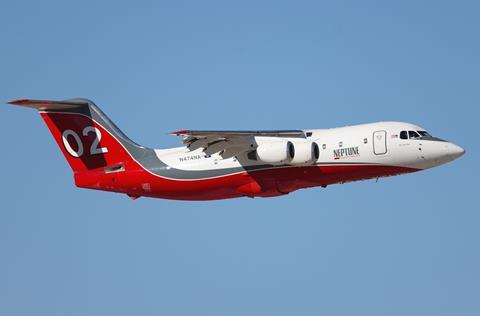
The US Forest Service notified the National Transportation Safety Board last year of corrosion found on a Neptune Aviation Services BAe 146-200, operating as Tanker 02, and McDonnell Douglas MD-87 operated by Aero Air as Tanker 106.
Retardants based on phosphate salts – including monoammonium and diammonium phosphate, or ammonium polyphosphate – had long been used, without problems.
But the Forest Service granted conditional qualification to two new retardants – based on magnesium chloride, and known as FR-100 and FR-200 – in 2021.
According to the safety board, these retardants had “successfully completed” specified corrosion testing, but points out that these tests had been “unchanged for many years” and only examined effects of one retardant on single alloys of aluminium, steel, brass and magnesium.
As early as June 2021, evidence began to emerge during operational tests of chemical incompatibility between the magnesium chloride-based and phosphate-based retardants when they were comingled in service.
“Operators indicated that mixing of the two retardants resulted in a thick, congealed, gel-like substance that adhered to the tank structure when wet and a thick, clay-like substance when dry,” says the safety board.
“The substance interfered with the operation of float sensors, valves, flow meters, and seals and required mechanical means for removal. Corrosion of actuators and a breakdown of surface coatings were also reported.”
Despite this evidence, and without additional corrosion testing, the Forest Service commenced an integration operational field evaluation during the 2023 fire season.
This involved using the two airtankers. Both initially carried only the new FR-200 retardant but, for the second part of the season, alternated between FR-200 and the phosphate-based retardant MVP-Fx.
When the season ended, maintenance personnel found significant evidence of corrosion on the internal tank structure and components of the aircraft, as well as the external airframe structure, says the safety board.
Concerned that there was potential for “more serious corrosive effects on airtankers that could lead to an accident”, the Forest Service requested that the safety board examine the aircraft and investigate the cause, the inquiry adds.
The BAe 146 had been operating as an airtanker since 2017, and inspection ahead of the 2023 season revealed no corrosion. The MD-87 had been flying its first season as an airtanker following conversion in early 2023. Its retardant tank was new.
Each aircraft dropped only FR-200 until August 2023, before alternating between FR-200 and MVP-Fx for the three months to mid-November.
Examination of the Bae 146 turned up “significant signs” of corrosion to the retardant tank, says the safety board, particularly in areas adjacent to fasteners or joints.
But there was “much more evidence” of corrosion on the newly-converted MD-87, not limited to the tank, with multiple individual locations identified on the lower airframe aft of the tank exit.
“The most significant structural item that had corrosion was the right-wing forward spar lower cap doubler,” says the safety board, pointing out that the aircraft manufacturer considers this a primary structure.
Aero Air also discovered corrosion on three Pratt & Whitney JT8D engines, all of which had been fitted to the MD-87 at some point during the operational evaluation. The most severe corrosion was found on the right-hand engine, which had been in place for the whole of the evaluation period.
This corrosion on the right-hand engine affected the cases, spacers, disks, blades, and shafts, says the inquiry, while issues were found on similar parts of the left engine.