











Swapping the angle-of-attack sensor overlay plates on a Gazpromavia Yakovlev Superjet 100 led to last year’s fatal accident as the jet was being ferried from Lukhovitsy to Moscow after a maintenance visit.
Investigators from the Interstate Aviation Committee carried out several experiments and analyses in a bid to understand why two angle-of-attack sensors were feeding erroneous data to the aircraft’s flight computers, causing the jet’s stall-protection system to push it into a dive.
The inquiry into the crash revealed “violations” in documentation management and storage of components removed from aircraft during maintenance.
At the time the aircraft (RA-89049) was undergoing angle-of-attack sensor work, similar work was being undertaken on two other Gazpromavia Superjets (RA-89029 and RA-89018).
The inquiry states that investigators could not “reliably establish” the movement of the various angle-of-attack sensors, the overlays which attach the sensors to the fuselage, or the covers which ensure the fuselage remains aerodynamically flush.
Crucially the overlay – relative to which the sensor is positioned – is “non-interchangeable” and the technical operation manual includes a cautionary note stating that the overlay must only be re-installed on the same point of the fuselage from which it was removed.
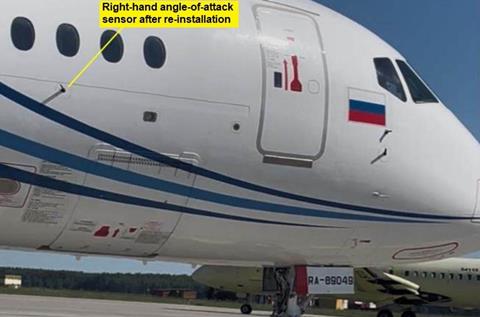
Investigators examined aircraft RA-89018 but ruled out the possibility that the overlays from this aircraft had been installed on the ill-fated Superjet.
Four other Superjets were analysed to determine the potential effect of installing the overlays on the correct airframe, but with the right-hand overlay in the left-hand position, and vice-versa.
This analysis showed that the overlays could be swapped and, when adjusted to align with their mounting-bolt holes, would each generate erroneously-high angle-of-attack measurements.
After a technician installed the left-hand angle-of-attack sensor on RA-89049 on 8 July last year, a second technician – in the other’s absence – fitted the right-hand sensor the next day.
This second technician testified to investigators that there had been momentary “doubts” over the right-hand installation because the overlay could not initially be aligned with the bolt holes.
The inquiry points out that before dismantling the sensor assembly, marks are supposed to be applied to the overlay and fuselage in order to ensure correct replacement and alignment during re-installation.
Inaccurate angle-of-attack readings during the ferry flight on 12 July, three days after the sensor installations, were the result of “mixing up” the left- and right-hand overlays, the inquiry has concluded.
Unaware of the maintenance error, the Superjet’s crew believed the aircraft’s unexpected behaviour was the result of unreliable airspeed indications.
As the pilots attempted to regain control, they inadvertently allowed the aircraft to reach excessive speed, and a combination of the aircraft’s stall- and overspeed-protection systems caused it to enter a high-speed dive from which it failed to recover.