















Some US regional airlines see increasing opportunity to operate flights outside the bounds of capacity purchase agreements with major US airlines, with one carrier, CommuteAir, considering launching a new operation serving small US cities.
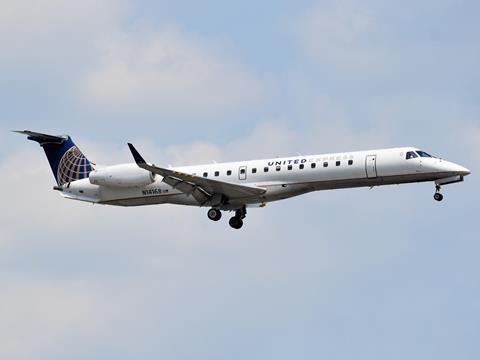
CommuteAir currently flies Embraer ERJ regional jets as United Express.
But the Ohio-based airline’s chief executive Rick Hoefling, in considering his company’s long-term strategy, sees opportunity for CommuteAir to provide regional connections outside the bounds of its contract with United.
“We’re looking at potentially doing our own service – our own branded service,” Hoefling tells FlightGlobal.
“There’s a lot of opportunity here… If somebody doesn’t do it, we are going to do it,” he adds. “We’re just trying to work through what… those economics look like.”
Hoefling says CommuteAir, which is part-owned by United, has a non-disclosure agreement with turboprop maker ATR that involves “looking at [the] North American space”.
His comments come as start-up JSX, a US charter carrier operating scheduled flights, seems to be enjoying success operating niche routes between cities that otherwise lack air service.
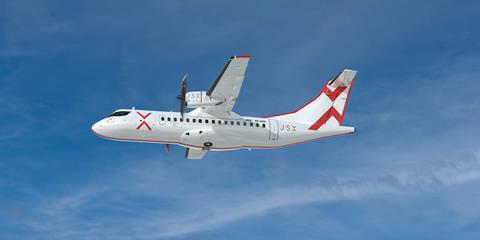
JSX, in business for six years, targets premium passengers and operates nearly 50 Embraer ERJs. It is now expanding, with plans to acquire four leased ATR 42-600s.
The majority of US regional airlines now fly under agreements with the three majors: American Airlines, Delta Air Lines and United Airlines. The Big Three also own or part-own many of their regional affiliates.
Over the last several decades a handful of regional carriers have taken the risk of going out on their own and establishing unique-branded airlines operating outside agreements with the majors.
Successes have been limited.
But Hoefling and JSX CEO Alex Wilcox say broad airline consolidation in recent decades, combined with a trend by airlines to operate larger jets, have seen carriers broadly retrench from many small markets.
Decades ago, US skies were filled with 19-seat turboprops buzzing between places within the same regions, linking, for instance, towns in New England to each other, and to cities like New York, Boston, Pittsburgh and Washington.
Many of those carriers failed or merged into larger companies. In the process, US airlines divested nearly all turboprops in favour of 50-seat regional jets, which more recently they have been replacing with 76-seat regional jets.
Along the way, airlines retrenched from smaller US markets and routed nearly all flights through major hubs. Between 2009 and 2025, about 40 US cities lost scheduled air service, with small cities suffering most, according to the Regional Airline Association.
“Demand is now requiring everybody to go through larger hubs,” says CommuteAir’s Hoefling. “If you’re in these smaller cities, you don’t have direct service anymore.”
US regional carriers now operate about 300 50-seat jets, including CRJ200s and Embraer 145s.
Last week in Washington, DC, Franco-Italian turboprop manufacturer ATR estimated that most of those jets will need to be retired by 2035.
ATR says 30 more US cites could lose all air service if carriers fail to replace the 50-seaters.
Hoefling was on hand last week when ATR presented those figures to airline CEOs in Washington, DC. The turboprop maker is pitching its aircraft as ideal replacements for the small jets.
Of ATR’s figures, Hoefling says, “They are not the only ones seeing that [opportunity]… Nature abhors a vacuum.”
He notes some ultra-low cost US carriers have recently been nudging into untapped secondary markets. Start-ups Avelo Airlines and Breeze Airways are examples. Allegiant Air has for years been flying secondary routes, and doing so successfully.
But Hoefling notes some ultra-discounters are now struggling and says many small cities have insufficient demand to support the Airbus and Boeing jets those larger carriers fly.
FEW AIRCRAFT OPTIONS
He is unsure what aircraft might work for an independent CommuteAir operation but says ERJs are a possibility, as are E170s – CommuteAir now operates one E170 under its charter division.
Hoefling likes what he sees from ATR, which is now offering its 42-600, typically a 70-seat aircraft, in a 50-seat configuration that includes first-class seats.
ATR is also working to land a US launch customer for 42-600s with forward boarding doors. The type can now only be boarded from an aft door, a feature US airlines have long viewed as a drawback.
“Whatever we do, it’s going to be premium-esque,” Hoefling says. “If we go down this path of branded services, it should feel like everybody else’s service at the mainline level.”
Other regional airlines that have struck out on their own include Atlantic Coast Airlines, a former Delta and United feeder that broke with those partners two decades ago to form Independence Air.
That carrier, with nearly 100 CRJ200s and several Airbus A319s, operated a traditional hub from Washington Dulles International airport. It failed in less than two years amid high fuel prices and intense competition.
Mesa Air Group, parent of United feeder Mesa Airlines, in 2006 launched an independent operation in Hawaii under the name Go! Mesa shuttered Go! in 2014.