













Airbus has lowered its target for A220 production rates, aiming for 12 aircraft per month next year rather than the previous 14.
The airframer is attributing the decision, disclosed during a third-quarter briefing, to the “current balance between supply and demand”.
Airbus, which took net orders for 36 A220s over the first nine months of this year, has delivered just 62 of the twinjets over the period. The backlog for the A220 stood at 490 aircraft at the end of September.
Chief executive Guillaume Faury says the “adjustment of the ramp-up trajectory” allows time for integration of work packages from Spirit AeroSystems, which include wing manufacture for the A220, as well as the introduction of engine durability improvements for customers.
The A220 is powered by Pratt & Whitney PW1500G engines.
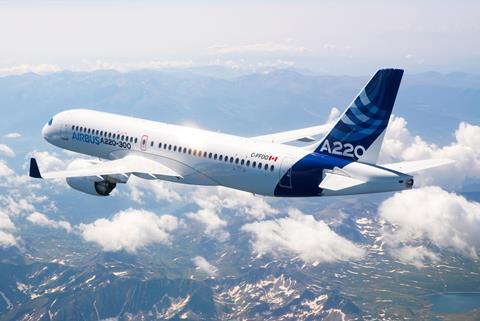
Faury insists the company is “not dropping” the original monthly rate target of 14 A220s, although he does not indicate when it might be achieved.
Integration of the Spirit work packages for the A220 is “changing a bit the picture” regarding the point at which the programme breaks even, he says, adding that it is “a bit premature to be more specific on a date and the way to get there”.
But the manufacturer’s other aircraft production plans remain unchanged. It is still aiming for a 75-per-month rate on the A320neo family in 2027, and 12 per month for the A350 in 2028.
The airframer also confirms the A330 monthly rate will stay at four aircraft until 2029 when it rises to five.
Faury says the “complex and dynamic” operating environment means deliveries are still “very backloaded”.
The company handed over 507 commercial jets in the first nine months of the year, including 33 A350s and 20 A330s.
But Airbus is maintaining its full-year delivery target of 820 aircraft.
“We continue to expand our industrial capacity to support the commercial aircraft ramp-up,” adds Faury. The company has recently opened new A320neo-family production lines in Mobile and Tianjin.
Over the first nine months the commercial aircraft division generated revenues of €33.9 billion ($39.5 billion), up 3%, while adjusted earnings rose by 8% to €3.27 billion.
Faury says the revenue performance reflects the higher level of deliveries as well as growth in services.
Airbus adds that, with regard to earnings, the increase in deliveries “embeds and unfavourable mix” and the earnings figure reflects a “more favourable hedge rate” and lower research and development expenditure.
Adjustments to the company’s earnings include an €88 million impact from “stabilisation costs” for work packages relating to Spirit AeroSystems. Airbus is set to acquire several commercial aircraft work packages from Spirit as part of Boeing’s planned takeover of the US firm.