


















Boeing has downplayed as “misleading” a report saying it made a strategic shift by taking new steps toward developing its next single-aisle aircraft.
Some financial analysts agree.
The Wall Street Journal reported on 29 September that Boeing is planning to develop a 737 replacement and that chief executive Kelly Ortberg in February met in the UK with Rolls-Royce executives, who pitched the Boeing chief on a new engine for a future narrowbody jet.
The article said Boeing has now made a “shift” in pursuing the next aircraft.
In its initial response, Boeing stressed it remains primarily focused on executing its recovery plan, adding, without mentioning any new aircraft, that it is always evaluating new products.
But in a 30 September communication to employees, Boeing pushed back more firmly.
“Boeing has clarified misleading media reports that it launched new work on a single-aisle replacement airplane, reiterating that the company will only move forward when the market, technology and the company itself are ready,” says the internal communication.
“Boeing continually conducts configuration studies as part of its product development baseline work.”
However, the airframer does not specify why it thinks the article is misleading.
In a 1 October research report, investment firm Bernstein echoed those comments, saying the Journal report was ”a misleading story”.
For several years, Boeing has insisted its primary focus is recovering from its recent troubles, by addressing quality problems, ramping deliveries, strengthening its financial health and achieving certification of its 737 Max 7, Max 10 and 777-9.
Meanwhile, the company has made no secret it has projects underway related to developing its next narrowbody aircraft, thought to be a 737 replacement or a larger so-called “new mid-market aircraft” (NMA). It has completed market studies and engine reviews and is pursuing various technologies, including long and thin wings under a NASA-assisted effort.
A source familiar with Boeing’s production system tells FlightGlobal the company has tested composite components for a potential NMA – an aircraft some observers suspect Boeing might bring to market before a 737 replacement. Those components have been produced using processes similar to those used to manufacture some 787 components, the source says.
Boeing has cast such work as part of its long-held strategy of examining technologies and market conditions in preparation for an eventual programme launch, a milestone that would signal its commitment.
Some financial analysts see no evidence that strategy has now shifted.
“We see no chance Boeing seeks to expedite launch of a new narrowbody,” Bernstein’s report says, noting that 737 Max production is sold out through 2031 and expressing doubt the company would “cannibalise its own market” by introducing a new jet soon.
“We continue to see a target in-service date for a new narrowbody as around 2038 for both companies,” it says, referencing new products from Airbus and Boeing. “No one should worry about Boeing spending large near-term sums on an early launch.”

Similarly, a 30 September JP Morgan research report said: “We do see Boeing developing a new aircraft at some point, and it would be odd if the company were not exploring new technologies and opportunities.
“The recent news on its own, however, doesn’t leave us thinking differently about a new aircraft launch.”
Ortberg addressed future aircraft during the company’s second-quarter earnings call in July, saying engine technology is yet too immature and that neither Boeing nor the broader market are ready for a new jet. “We’re maturing all of those,” he said. ”That’s not today and probably not tomorrow”.
Then on 11 September, Ortberg said Boeing is unlikely to launch an aircraft development programme until the Federal Aviation Administration streamlines its certification process. Boeing’s Max 7, Max 10 and 777-9 have lingered in that process for years amid heightened scrutiny by the regulator.
“It’s way too slow,” Ortberg said. “We’ve got to work with the FAA in swinging the pendulum back and making that a process that will work. I can’t imagine that we can do a new airplane without having that process refined.”
Analysts also downplay the significance of Ortberg reportedly meeting with Rolls-Royce to discuss a future engine.
“It is not surprising for Boeing to consult with engine makers, and we imagine the company may be talking with [CFM International] and with [Pratt & Whitney], too,” JP Morgan writes.
Bernstein doubts Boeing would turn to Rolls-Royce for a narrowbody aircraft engine, saying most-likely contenders are CFM’s in-development open rotor and Pratt & Whitney’s updated geared turbofan.
“One should not expect Boeing (or, for that matter, Airbus) would decide to launch a new airplane with a Rolls engine ahead of likely higher-performance offerings from CFM or Pratt,” Bernstein says.
Rolls-Royce has been pitching its UltraFan architecture as a potential contender for a new narrowbody engine.
Boeing’s public response to the Journal article says: “Our teams continue to be focused on our recovery plan, including delivering on our existing backlog of nearly 6,000 commercial airplanes and certifying the new 737-7, 737-10 and 777-9 models”.
“At the same time, as we have done over the decades, our team evaluates the market, advances key technologies and improves our financial performance, so that we will be ready when the time is right to move forward with a new product,” it adds.
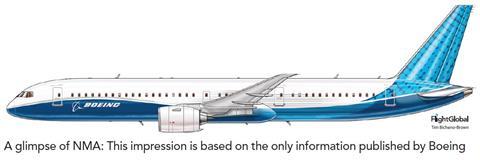
Boeing had several years ago been close to launching its NMA but shelved the project amid the 737 Max’s grounding and subsequent quality problems. At the time, the NMA was to carry up to 270 passengers and have 4,000-5,000nm (7,400-9,300km) of range.
Meanwhile, Airbus has had enormous success selling long-range variants of its A321neo, which fill the mid-market niche.