
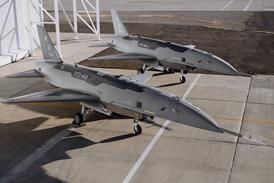















Russian research efforts to create a new supersonic civil aircraft demonstrator have edged forward with completion of a phase of engine model testing.
The technology demonstrator – known as ‘Strizh’, the Russian term for ‘swift’ – could fly before the end of the decade, although this would depend on the project’s being allocated sufficient funding.
According to the Moscow-based Central Aerohydrodynamic Institute, development of a next-generation supersonic aircraft is a “critical task”.
“Supersonic civil aviation is of strategic importance to the state,” says general director, Kirill Sypalo.
“Recent research has demonstrated Russia’s technological capabilities and allows us confidently to continue our work in this area.”
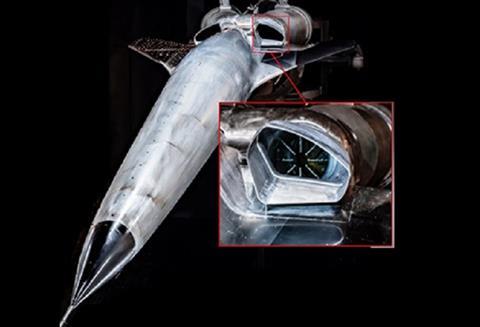
Strizh relies on an overhead propulsion system to reduce the problematic shockwave that accompanies transonic acceleration.
The institute says it has manufactured models of the powerplant components during its latest research programme.
It comprises two engines, each with a shallow oblique intake.
Windtunnel testing indicates that the overhead intakes demonstrated capabilities that “exceeded” standard levels, while thrust losses from the unusual design were “acceptable”, claims the institute.
Several research centres and industrial enterprises are participating, among them United Aircraft, United Engine’s Klimov division, and the Central Institute of Aviation Motors.
Klimov’s RD-93MS engine is being used for ground testing. The powerplant is derived from the engine used in the Chengdu/PAC JF-17 combat aircraft, and adapted for the Strizh demonstrator.
A noise-suppression system was developed by the Central Aerohydrodynamic Institute and fitted to the engine’s flat nozzle to reduce noise during take-off.
It states that the engine’s thrust performance, assessed during the tests, “confirmed its compliance with technical specifications”.