



















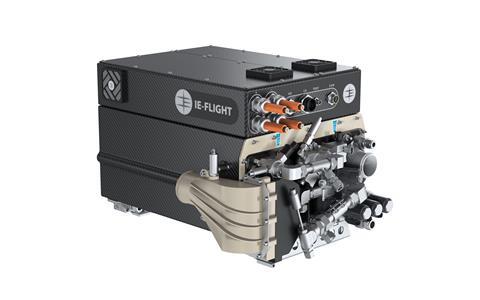
Intelligent Energy intends later this year to freeze the design for a lighter, low-drag, hydrogen fuel cell system being developed under a UK-funded initiative.
Built around the company’s long-standing phase-change cooling technology, development of the 300kW system is backed by the UK Aerospace Technology Institute (ATI), under a project called HEIGHTS.

Kicking off in May last year, the £17 million ($22.8 million) effort is now working towards its design-freeze milestone, says Jonathan Douglas-Smith, head of business development for IE Flight, the company’s aviation unit. This will be achieved in the third quarter of 2026, he adds.
“It has been in conceptual design for some time, and we are currently going through the process of revalidating the performance of the integrated system against market and customer requirements.
“Parameters for mass, efficiency and drag are well understood by potential users and will be accommodated within the design.”
Intelligent Energy is already developing high-performance aerospace-grade fuel cell stacks as part of the GKN Aerospace-led H2GEAR project, also supported by the ATI.
These stacks will be tuned to maximum performance through H2GEAR – due to wrap up in 2026 – “which feeds into HEIGHTS really well”.
And, says Douglas-Smith, its participation in H2GEAR is what drove Intelligent Energy to develop its own fuel cell system ready for integration into powertrains.
“We quickly found out from the market that many of customers wanted a complete fuel cell system – hydrogen in and electricity out – as building the balance of plant around a stack can be a significant challenge.
“There is significant engineering scope with making a lightweight fuel cell system and that’s what HEIGHTS seeks to resolve.”
Douglas-Smith says the evaporative phase-change cooling system with high-temperature architecture “will make fuel cell-powered aircraft, from a propulsion point of view, more viable in the future”.
Fuel cells are more efficient and have better longevity when they run at a lower temperature, but using a high-temperature system makes it easier to reject the heat produced, allowing a smaller, lighter cooling system, with lower drag.
Intelligent Energy’s solution is to decouple the operating temperature of the stacks from that of the cooling system, essentially “taking advantage of the best of both worlds”, says Douglas-Smith.
Although based on a low-temperature proton exchange membrane (LT-PEM), running at about 80°C (176°F), the temperature of the exhaust stream can be as high as 130-140°C.
Intelligent Energy’s solution uses an air-cooled condenser, offering a smaller frontal area than conventional liquid-cooled fuel cells, circulating a water/glycol mix to cool the fuel cell.
It then injects water directly into the fuel cell stack, which then evaporates as it absorbs the heat produced.
Heat from the reaction is contained in the cathode exhaust fluid, saturated with water vapour. Liquid water for re-injection is recovered through cooling this stream in the condenser.
To achieve a higher heat rejection temperature, this cathode exhaust fluid is pressurised by a second-stage compressor – sitting between the fuel cell and condenser – boosting the pressure and raising the condenser operating temperature.
The hot-side exhaust from the condenser reduces in pressure across a turbine, recovering power input to the second-stage compressor, before the waste gas is expelled into the atmosphere.
With a higher temperature difference between the condenser exhaust temperature and the atmosphere, the condenser reduces in size.
For instance, with an ambient temperature of 30°C, the heat exchanger could be 40% smaller when compared to market-competitive liquid-cooled solutions.
While in its early stages, Douglas-Smith is confident the project is “running on track” to move to testing at technology readiness level (TRL) 5 by the end of 2027. That will see the full system run at a simulated altitude in a barometric chamber.
Intelligent Energy brands the system as IE-Flight 300, for which it already has customers lined up. Initial deliveries will begin in around 2028, he says, leading to flights of demonstrator aircraft using the fuel cell system towards the end of the decade.
Scalable design
In its 300kW guise, the system is intended for electric vertical take-off and landing (eVTOL) aircraft or smaller Part 23 commuter types with six to 12 seats, then scaling to 19-seat and auxiliary power unit applications.
Thanks to its modular design, however, it can later be scaled up to power larger Part 25 aircraft.
“That’s the intention as we have already received a huge amount of interest from Part 25 manufacturers and tier one suppliers who are interested in much larger passenger aircraft and we have signed agreements with those players,” he adds.
An ATR-sized regional turboprop requires around 8MW of power, and if driven by a fuel cell system, will also need to dissipate 8MW of heat.
Those challenging operating parameters are driving the industry towards high-temperature solutions for larger applications, Douglas-Smith notes, and he sees HEIGHTS as addressing that need.
Also involved in HEIGHTS are the University of Sheffield Advanced Manufacturing Research Centre, the Manufacturing Technology Centre, and Coventry University.