






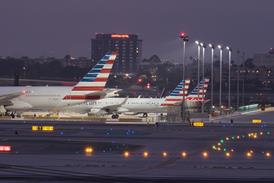
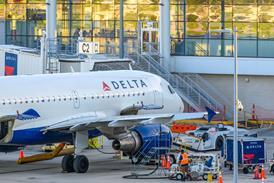
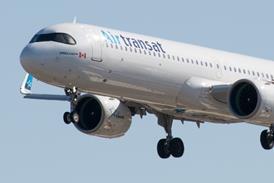
The US Supreme Court’s decision to strike down many of US President Donald Trump’s tariffs, followed immediately by the president’s pledge to implement new import duties, has thrown another shroud of uncertainty over the aerospace sector.
Critically, while the industry has been exempt from many of Trump’s tariffs to date, it is unclear if the same carve outs will apply to new tariffs Trump says he is set to impose.
“We, as an industry, have been effective in making the case that zero tariffs are good for aerospace,” says Jonathan Epstein, partner at law firm Holland & Knight. “One of my concerns is that in a rush to implement new tariffs… the [administration will] inadvertently not include the carve out.”
Also unclear is how the court’s decision could affect the various trade deals Trump negotiated in the last year, many of which involved countries and their airlines ordering Boeing jets.
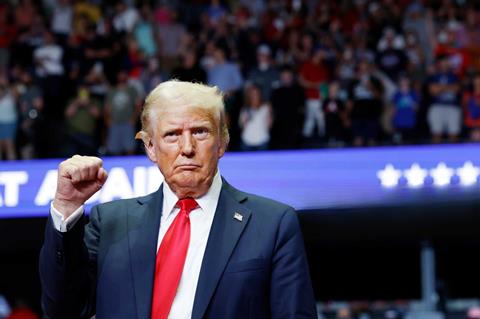
Asked about those agreements on 20 February, Trump said, “Countries that have been very good to us will be treated very well”.
He cited Vietnam as an example. Notably, two days ago, coinciding with a state visit to Washington by Vietnam leader To Lam, Vietnam Airlines ordered 50 737 Max and two other Vietnamese airlines – Sun PhuQuoc Airlines and Vietjet – committed to acquire dozens of 737 Max and 787s.
By a 6-3 ruling, the Supreme Court on 20 February ruled that the US International Emergency Economic Powers Act (IEEPA) does not grant the US president authority to impose tariffs.
Trump claimed that law as authority for slapping tariffs against Canada, China and Mexico for the stated purpose of slowing the flow of illicit drugs to the USA. He also invoked the IEEPA to levy “reciprocal tariffs” of at least 10% (in some cases, such as with China, much greater) against all other nations, with exceptions, for the stated reason of addressing trade deficits.
The court’s ruling does not impact tariffs implemented under authorities other than IEEPA.
The aviation industry has so far escaped much of the pain because the administration exempted aircraft and aircraft parts from tariffs on Canadian, Mexican, EU and UK products. Imported Brazilian aircraft and aircraft parts had been subject to a 10% duty but exempt from a broader 40% tax. The aerospace sector has, however, been impacted by the Trump administration’s tariffs on aluminium imports.
Following the Supreme Court decision, Trump doubled down by promising new import duties.
“Other alternatives will now be used to replace the [tariffs] that the court incorrectly rejected,” he says. “I’m going to go in a different direction… which is even stronger.”
Within days, Trump says, his administration will impose new 10% tariffs on all imports, doing so under authority of section 122 of the US Trade Act of 1974. That law lets US presidents impose tariffs up to 15% for up to 150 days to address “international payment problems”.
The legality of that plan has already been questioned.
Trump also says more tariffs could come under Section 301 of the Trade Act of 1974 (which allows presidents to impose tariffs to address unfair trade practices) and Section 232 of the Trade Expansion Act of 1962 (which permits tariffs to address imports that threaten national security).
Critically, however, those paths require formal reviews prior to implementation – a far different process than Trump followed when imposing his global 10% tax.
Indeed, the US Department of Commerce is already in the middle of investigating aerospace trade practices under Section 232. Though that inquiry could possibly lead to tariffs, a broad swath of aerospace players have submitted comments urging that aerospace products remain tariff-free.
“Trump will almost certainly go down the path of 232 or 301,” says Richard Aboulafia, managing director at AeroDynamic Advisory. “That raises the question: will [aerospace] still be protected?”
The analysts generally view the Supreme Court’s decision as shifting some tariff power away from the president and back to Congress.
Aboulafia suspects the decision might “de-risk” the global trade environment and even the USA’s relationship with China.
Another open question is whether, owing to the court ruling, companies that already paid tariffs will be due refunds. They might – but the money will not likely come quick or simply, Epstein says.
“There is a process, and it takes time, and the government will hold the money as the process” unfolds, he says.
Asked about refunds, Trump says, “I guess it’ll get litigated for the next two years.”