














Hydrogen powertrain developer ZeroAvia has warned that without a successful conclusion to its current Series D investment round it lacks financial resources to continue supporting operations in their current form beyond the first quarter of 2026.
However, the firm aims to close the ongoing funding push in the third quarter, the latest accounts from UK subsidiary ZeroAvia Ltd disclose.
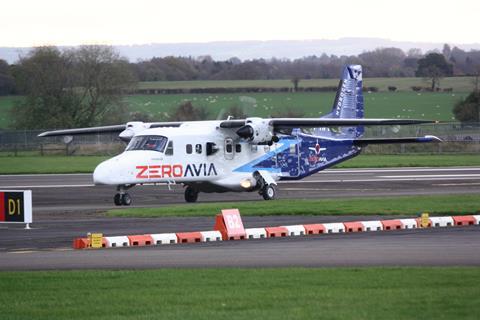
Headquartered in California, the company has additional operations in Everett, Washington and at Kemble airfield in the UK.
Signed off on 4 June but only filed to Companies House on 23 September, the accounts – covering the period to end-December 2024 – state that the UK business is “dependent on financial support” from the US parent to “fund its operations and development roadmap”.
Day-to-day capital requirements at the UK operation are funded by loans from its US parent, the report says; in 2024, ZeroAvia Inc provided loans totalling £28.9 million ($38.5 million) to its subsidiary.
“While the parent currently has sufficient liquidity to support operations through to Q1 2026, it is in the process of securing additional equity funding to meet group-level needs beyond this period,” the accounts state.
Without that additional money, there is “material uncertainty” surrounding the UK company’s ability to continue as a going concern, it says, adding: “A delay or failure to raise funding at the parent level could adversely affect the company’s ability to progress development work.”
ZeroAvia Ltd’s auditor KPMG notes that “at the time of approving the financial statements [in June], the process to raise additional funding has commenced but has not been secured”.
Outlining its reasons for adopting a “going concern basis” for the financial statements – deemed appropriate by its auditors – the company says the Series D round is “targeted to close in the third quarter of 2025”.
ZeroAvia Inc “is actively engaged” with existing investors and conducting due diligence on potential new investors, the report adds.
“While the latest funding round is not guaranteed until formally committed and this remains a risk, the directors believe there is substantial interest in this financing round, and based on the success of previous funding rounds, are confident that sufficient financing will be secured.”
The accounts provide no clarity on the progress of those discussions or the amount being sought. ZeroAvia declined to comment.
In June, chief executive Val Miftakhov told FlightGlobal the company was seeking $150 million through the latest investment round, which it hoped to conclude at the end of the summer.
As a privately owned US company, ZeroAvia Inc does not publicly disclose its financial performance.
Notably, the only “post-balance sheet” event flagged in the report is the award in early 2025 of £5.6 million in UK government research funding for a project called LH-SIFT related to cryogenic liquid hydrogen.
Nonetheless, the accounts are clear that the UK business is almost wholly financially reliant on its parent company.
They state that the “company will require additional funds” from ZeroAvia Inc to meet near-term liabilities as they fall due over the 12 months to end-June 2026 – the going concern assessment period.
ZeroAvia Inc has indicated it will continue make these funds available and will also not seek repayment of monies due to the group over the period, it says. In total, ZeroAvia Ltd owes £46.9 million to its parent, of which £43 million falls due within one year.
For the 12 months covered by the accounts, ZeroAvia Ltd recorded a loss of £35.9 million, up from a £28.7 million loss in 2023.
Turnover stood at £2,990 down from £40,000 a year earlier, while research and development spending nudged up to £10.9 million, from £7.9 million in 2023. Its government research grant income rose from £1.7 million to £2.1 million.
Net liabilities stood at £59.9 million, against £32 million at the end of the prior year.
ZeroAvia aims to secure UK Civil Aviation Authority (CAA) certification for its 600kW ZA600 powertrain in late 2026 or early 2027, enabling entry into service aboard a Cessna Caravan later that year.
Initial tests of the powertrain ended in April 2024 after a dozen flights aboard a modified Dornier 228 turboprop (G-HFZA) from Kemble.
That aircraft is now undergoing modification as part of the LH-SIFT project to fit and fly a liquid hydrogen tank while retaining the existing fuel cell powertrain.
ZeroAvia says the required installation and infrastructure work have been completed, and that it is “targeting October for the first prop spin on a fully integrated aircraft”.
In the meantime, it has been conducting ground testing of a certification-intent version of the ZA600 system at Kemble and is “commissioning a full engine test rig at a new facility on the other side of the runway”.
In June, Miftakhov said the company planned to install that powertrain aboard a second Do 228 (N409VA) in the third quarter, with a goal of flying that aircraft by year-end.
Meanwhile, a company-owned Cessna Caravan (N308AD) has been sighted performing multiple ground runs at Kemble.
That aircraft remains in its original configuration but is later to serve as a flying testbed for the ZA600 system.
Before that, ZeroAvia plans to make some exterior changes to the Caravan in line with those expected from the ZA600 retrofit, “to validate the aerodynamics we have seen in windtunnel testing”.
ZeroAvia says it is making “good progess” in agreeing the certification basis for the powertrain with the CAA but declines to comment further.
This article has been edited to correct turnover figures in the 20th paragraph.