
















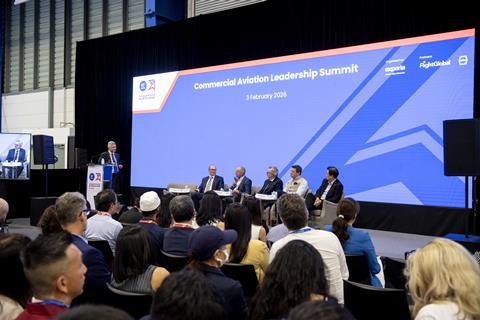
A panel of aviation leaders representing airlines, engine makers and aircraft lessors remain confident of continued growth in the Asia-Pacific, despite ongoing challenges like delivery delays.
Speaking at the FlightGlobal-hosted event on the opening day of the Singapore air show, the chief executives of low-cost operators Cebu Pacific and IndiGo highlighted the “massive” growth potential of their home markets – the Philippines and India, respectively – with a rising middle class having increasing disposalable income.
IndiGo’s Pieter Elbers notes that India’s growth “is still at an early stage”, citing a lower ratio of seats per capita in the country.
The airline’s large orderbook has made headlines on several occasions, and Elbers says this reflects the growth potential of travel demand on domestic and international routes.
Cebu Pacific’s Mike Szucs, meanwhile, notes that while there is an “immense desire” to travel, affordability remains “one of the most fundamental things” for the carrier.
“[We] can all add in this capacity in the hope that everyone’s going to come and fly on us – and there’s certainly the potential to do that – but it has to be done with a mind on the fact that [our customers] aren’t as rich as Americans or Europeans,” Szucs says.
Scoot CEO Leslie Thng says that while Singapore does not have the benefit of a large domestic market, the airline has identified Southeast Asia as a growth engine, a strategy behind its recent acquisition of nine Embraer 190-E2s.
Thng says the new aircraft have allowed Scoot to add 12 new points within Southeast Asia in the past 18 months.
Thomas Chandler, the chief operating officer of BOC Aviation, says that operating lease demand is strong in the region, with “high levels” of lease extensions as airline customers tackle delivery delays.
The panel agreed that while delivery delays and other supply chain issues were inevitable, it was important to build resilience.
Scoot’s Thng says the airline has “proactively” added spare engines, while IndiGo’s Elbers notes that while “every plane too late, or every engine too late is a missed opportunity”, the airline’s large order gives it some fleet flexibility.
CFM International president and CEO Gael Meheust notes that while the engine maker is working to ramp up production, demand “is incredible”.
“We know that our customers have expectations, and we were able to deliver the engines that both airframers [Airbus and Boeing]) were asking for us in 2025,” he adds.
The Commercial Aviation Leaders Forum was co-organised by FlightGlobal and Singapore Airshow organiser Experia and sponsored by CFM International.