
















Icelandair Group is keen to secure new collective agreements with key employees, after a loss-making 2025 in which the weaker US dollar against the Icelandic krona weighed on its profitability while exacerbating concerns about salary trends in its home country.
Speaking during a full-year earnings call on 6 February, chief executive Bogi Nils Bogason said that even amid productivity improvements in the business, current wage trends in Iceland are putting “unsustainable” pressure on companies such as Icelandair which book a significant proportion of their revenue in the weaker US currency.
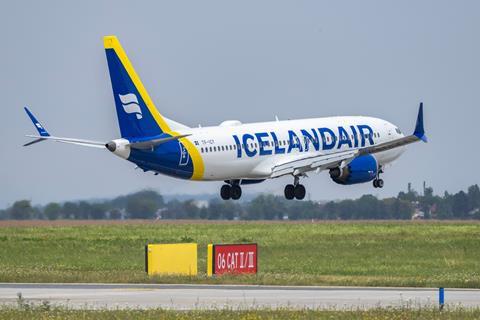
With collective bargaining agreements with cabin crew, pilots and maintenance staff having expired, current negotiations must therefore be focused on supporting Icelandair’s “long-term competitiveness”, he suggests, saying Iceland should adopt a more “Nordic” approach, where export-focused businesses “set designs for salary increases” in a country.
“The unsustainable contractual wage development in Iceland in recent years has significantly outpaced that in our neighbouring countries, which remains challenging for export companies that have most of their revenues in foreign currencies,” explains Bogason.
“Since 2020 the wage index in Iceland has increased by 49%, which is significantly higher than in our main competing regions,” he adds, pointing to a chart that suggests wage increases were around 27% in the UK and USA over the same period, and 17% in the Euro area and in other Nordic countries.
Bogason insists Icelandair’s and labour unions’ interests are “hand in hand” during current negotiations, saying there is agreement that “we need to be more competitive than we are today”.
Aside from his concerns around salaries and currency – and the high cost of carbon credits – Bogason was broadly positive about Icelandair’s prospects for 2026, as it focuses on point-to-point markets over “relatively weak” transatlantic demand.
Icelandair stops short of guiding for a full-year profit in 2026, but does say it expects an improvement on the losses achieved in 2025.
“This is driven by a strong hub position, positive booking status, and a rebalanced summer 2026 network, with growth focused on European destinations,” the airline says, adding of the wider group: “Profitability for the Leasing and Cargo segments is projected to stay strong.”
Icelandair reported a full-year net loss of $9.5 million for 2025, which represents an improvement on the $20.2 million loss it recorded in 2024.
Its operating loss of $17.2 million was, however, deeper than the $14.2 million loss it recorded in 2024. Icelandair notes that the negative impact of the weaker US dollar amounted to $43.7 million for the year.
Revenue for the full year was up 11% at $1.7 billion.
It plans to grow capacity by just 2% in 2026 after 8% growth in 2025.