









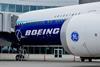

Boeing has discovered a durability problem affecting the GE Aerospace GE9X turbofans that power its 777-9, though executives say the issue will not likely throw off the company’s plan to deliver the first of the type in 2027.
News of the issue came as Boeing on 27 January reported turning a $2.2 billion profit in 2025, a year in which it ramped aircraft production and acquired former supplier Spirit AeroSystems.
Boeing’s 777-9 development and certification programme is already years behind schedule, beset by several technical problems and heightened scrutiny by the Federal Aviation Administration.

“We have identified a potential durability issue during a recent inspection on the 777-9 engine, and we’re working with GE to better understand that issue and finalise root cause and corrective action,” Boeing chief executive Kelly Ortberg says during the company’s earnings call.
“Importantly, as we work through this issue, we continue our certification flight testing, and we don’t expect this to impact our delivery in 2027,” Ortberg adds.
He does not elaborate about the problem and Boeing did not respond to a request for more information.
GE tells FlightGlobal, “We have an on-wing inspection programme in place to support Boeing while we analyse the issue and define the corrective action, guided by our safety and quality systems”.
Several engine and engine-related issues have beset the 777-9 programme. Boeing in 2024 grounded the test fleet after discovering failed thrust links – 13m (10ft)-long titanium devices that transfer thrust from engines to airframes.
Boeing subsequently made design changes intended to prevent the vibrations that caused the problem. That flight-test pause lasted five months.
Boeing also in 2022 halted 777-9 flight testing to address a GE9X temperature-related issue discovered during a borescope inspection.
And in 2019 an issue involving durability of stator vanes in the GE9X’s high-pressure compressor prompted a 777-9 programme delay.
The new durability concern aside, Ortberg says Boeing continues progressing with the 777-9 certification flight-test programme.
In the fourth quarter of 2025, the FAA approved Boeing to begin the third phase of flight testing under the 777-9’s Type Inspection Authorization (TIA).
“TIA 3 is a major phase of testing focused on avionics, environmental control systems and the auxiliary power unit,” says Ortberg. “Overall, the aircraft and engine continue to perform well.”
TIAs confirm an aircraft will likely meet certification standards and approve flight tests for certification credit.
The FAA has historically approved TIAs in their entirety but has recently been signing off on Boeing’s TIAs in stages.
Boeing’s $2.2 billion 2025 profit came as the company generated $89.5 billion in revenue, up 34% year on year.
It turned an $8.2 billion fourth-quarter profit, with revenue during that period surging 57% year on year to $23.9 billion.