
















GE Honda Aero Engines has started evaluating the business aviation market in preparation for an possible future launch of a new turbofan.
At oresent, the company only produces the HF-120 powerplant that equips the Honda Aircraft HA-420 HondaJet, a very light jet (VLJ).
GE Honda president Mel Solomon says the firm is for now only studying opportunities and is not yet close to committing to development.
But he expects an opening for a new engine, perhaps larger than the 2,000lb (8.9kN)-thrust HF-120, could arise in the coming years. Hybrid-electric propulsion systems are another area of potential interest.
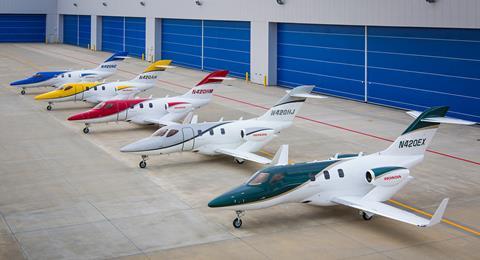
“We are looking at the light jet and even bigger than [the] light jet,” says Solomon. “I think the market is going to be ripe in the next five to seven years… I think we will see some activities in that area.”
“There is no sweet spot that we have identified” yet, Solomon clarifies. “Right now, we don’t see anything significant happening in the lower part of the market, especially in the VLJ market.”
GE and Honda Aero established the joint venture several decades ago to supply the HA-420 programme, with both partners supplying about half the HF-120’s parts. The manufacturer has produced about 500 HF-120s and assembles them at Honda’s site in Burlington, North Carolina.
Honda Aircraft continues producing HA-420s down the road in Greensboro, though it has shifted in recent years to focus on developing a larger variant called the HA-480 Echelon, a light jet that straddles the midsize segment. Honda Aircraft aims for 2028 certification.
That timeline left GE Honda Aero insufficient time to develop a new powerplant for Echelon, prompting Honda Aircraft to go with off-the-shelf Williams International FJ44s for the Echelon.
“Our primary focus right now is to ensure the fleet is properly supported,” Solomon says, adding that HF-120 production will likely continue for years.
“I don’t foresee the HondaJet stopping production anytime soon,” Solomon says. “As long as the demand is there for the aircraft, we will be making engines [and], hopefully, another engine product as well. We have some really good pedigree that we’re going to leverage.”
GE Honda Aero is also interested in possible opportunities to supply turbines – as turbogenerators – for hybrid-electric aircraft now under development.
Solomon does not specify projects, though companies including Maeve Aerospace and Heart Aerospace are developing hybrid-electric passenger aircraft.