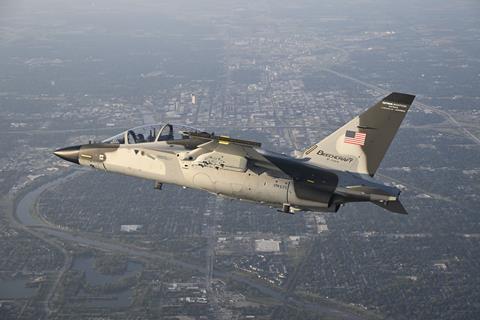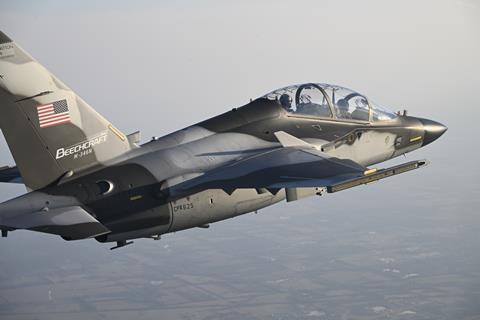














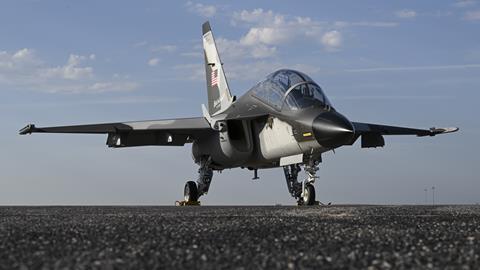

FlightGlobal was invited to fly aboard the new Beechcraft military trainer jet, including a demonstration of advanced simulation and training capabilities as developer Textron prepares its bid to replace the US Navy’s ageing Boeing T-45 Goshawks
“Looks like an Su-27,” crackles through the helmet radio. “Let’s see if we can get him.”
High above the endless prairie of America’s Great Plains, a lone fighter jet manoeuvres to meet the approaching Russian bandit.
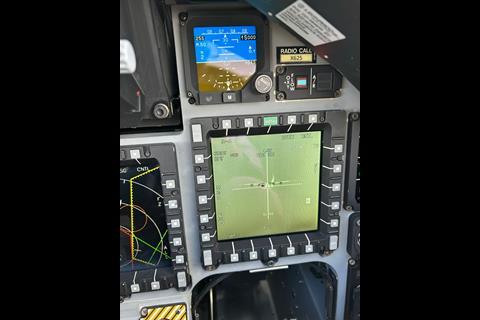
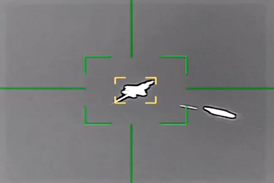
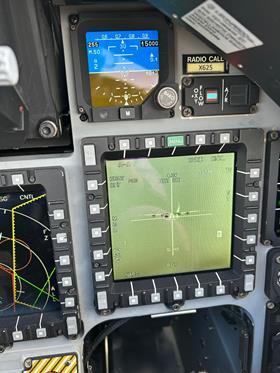
Inside the cockpit, three displays show the tactical situation, including an air-to-air radar lock on the approaching Russian jet, whose identity is visually confirmed on another screen, showing live black-and-white video coming from the onboard targeting pod.
“He’s almost close enough for a Sidewinder,” the pilot intones from the front seat.
The radar display disappears, replaced by an outline of the aircraft listing the weapons available to address the threat. The AIM-9X indicator blinks white just as the jet rolls into a 3.5g turn to orient on the threat.
Heads become heavy as hundreds of pounds of force compress lungs and relentlessly pull bodies backward into seats. Protective g-suits inflate around the legs of the two crewmembers, acting like extreme pressure cuffs to keep blood in the brain and prevent blackout.
The AIM-9X indicator briefly flashes green and a few moments later the Su-27 disappears from the video feed.
While a deadly intercept taking place within US airspace would normally be major international news, this engagement goes unremarked upon. That is because it didn’t actually happen.
While the friendly aircraft was indeed flying above the Kansas pasture with both the pilot and weapons officer stations occupied, the enemy aircraft and the missile that destroyed it were fictitious – having been generated by the jet’s onboard training system.
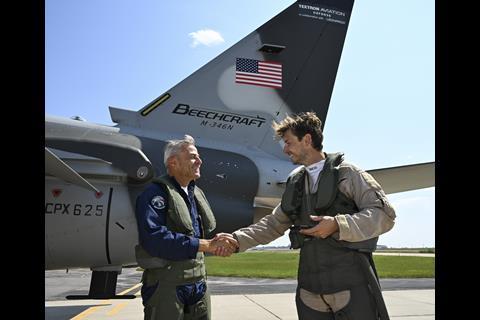
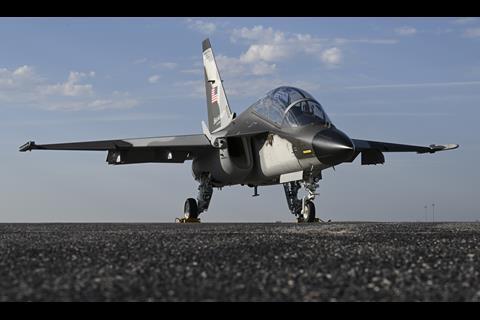
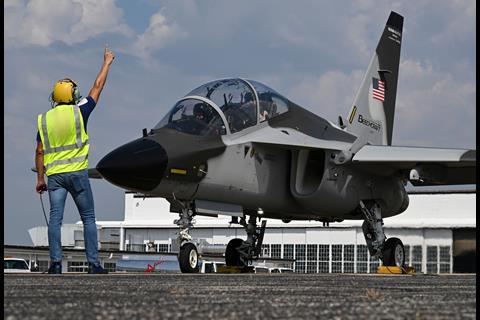
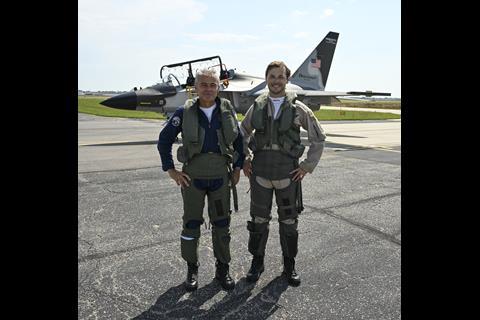
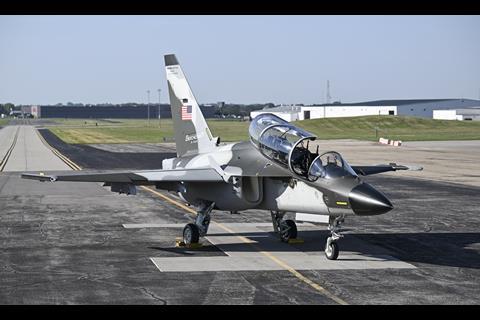
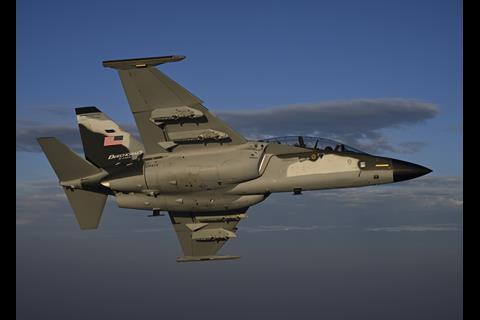
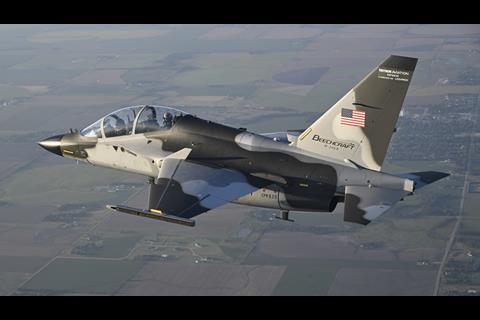
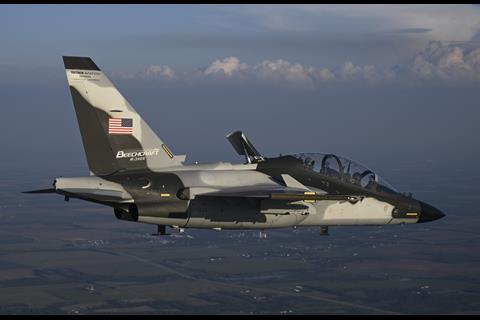
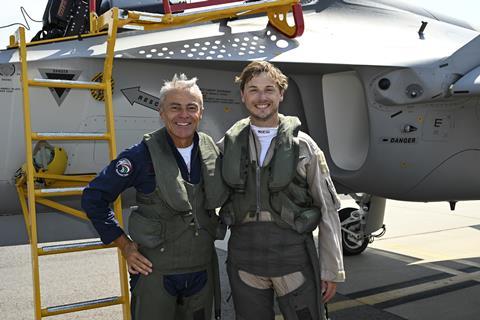
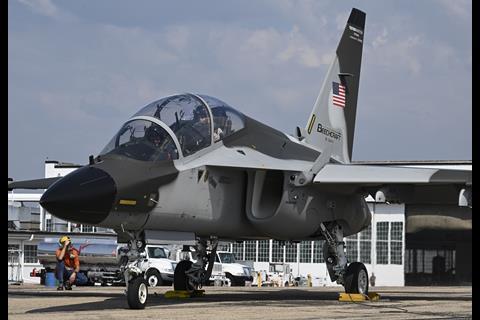
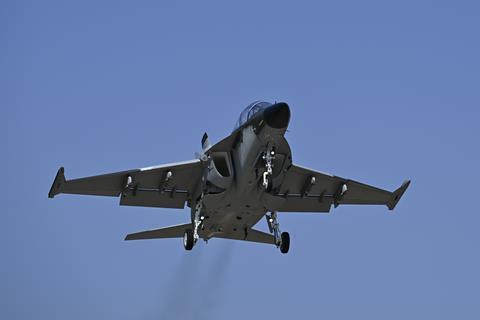
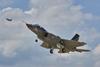
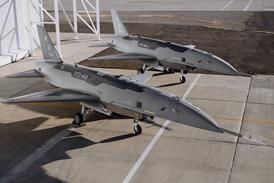
The flight on 16 September was the first public demonstration in North America of Textron Aviation’s new military trainer jet. FlightGlobal was invited to attend the event in Wichita, Kansas, which included a ride in the new Beechcraft M-346N test demonstrator.
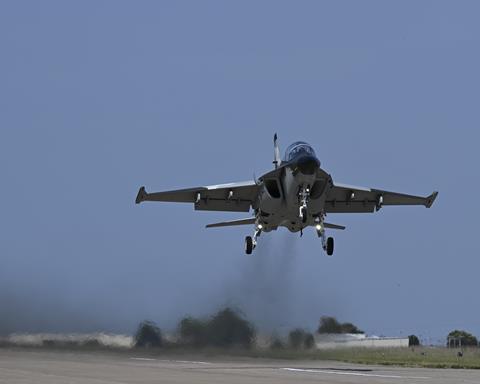
The product of a partnership between Textron and Italian airframer Leonardo, the M-346N will be derived from the latest Block 20 version of Leonardo’s popular M-346 trainer. With the new Beechcraft jet, Textron hopes to secure a win an upcoming competition to provide the US Navy (USN) with a new jet-powered trainer aircraft.
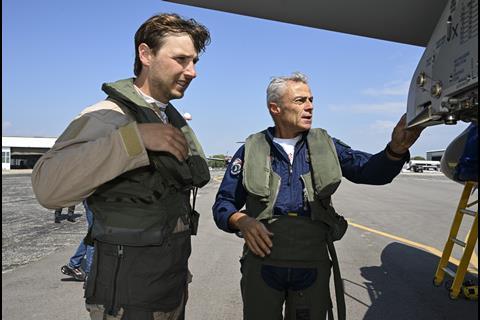
At the controls for FlightGlobal’s demo sortie was Quirino Bucci, a Leonardo test pilot and former officer in the Italian air force. Known as “QB” to his American counterparts at Textron, he puts both the twin-engined jet and its onboard reporter through their paces.
After successfully engaging the Su-27, the M-346’s Embedded Tactical Training System (ETTS) cues up two more targets, which turn out to be Lockheed Martin C-130J and Leonardo C-27J transports. Both appear on the radar display and electro-optical video feed.
While not included in the M-346N test demonstrator, which is based on one of Leonardo’s light attack M-346FA fighters, the final version of the Beechcraft trainer will also include an augmented reality cockpit system that will allow pilots to visually see the simulated targets on their visor.
That system will be included with Leonardo’s M-346 Block 20, which will also see the three multi-function panels in the cockpit replaced by a single large-area touchscreen display – a feature of many new and upgraded fighters, including the Lockheed Martin F-35.
Safety features like the Automatic Ground Collision Avoidance System, commonly known as Auto CGAS, are also being added.
After completing the air engagement, QB switches the ETTS to air-to-ground mode, much in the same way the pilot of a multi-role strike fighter can toggle between radar modes for different missions.
In this case, the training system allows students to replicate that experience without the need to install one of the costly and sensitive multi-function sensor arrays.
The training system populates a target on the ground-search radar display, which is overlaid with a navigational map. After getting a target lock, the black-and-white video feed on the right-side display shows a battery of SA-6 surface-to-air missiles.
Selecting a laser-guided bomb, QB pulls into a punishing 4g left-hand turn and puts the jet into a shallow dive to align on the target. Unassisted by the backseat weapons officer, who is in his own personal battle for consciousness, QB calls a “deadeye” malfunction on the automatic targeting laser and guides the bomb in manually – seemingly unaffected by the distraction of excess gravity pulling on his organs and muscles.
The ETTS offers real-time feedback on the bombing run, calculating a 62% rate of destruction on the target.
Not content with that result, QB quickly repopulates the SA-6 battery in a new location and cues a GPS-guided Joint Direct Attack Munition (JDAM). He then executes a rapid series of tight, 4g turns right and left to calibrate the weapon system.
Approaching the target, the air-to-ground radar shows the threat’s location and outlines a bubble of space that, if released inside, will ensure the JDAM achieves good effects on its target.
QB pushes forward into a steeper dive as the radar aperture ticks forward toward the optimal engagement zone. The targeting pod continues piping in live video of the truck-mounted missiles clustered below us, which are invisible to drivers on the nearby I-35 interstate.
Seconds after crossing into the engagement zone calculated by the ETTS, QB pickles the bomb and pulls out of the dive. The radar aperture switches over to glide slope graphic, calculating the JDAM’s time to impact based on our airspeed, angle of attack, and release altitude.
The GPS-guided bomb sees better results, achieving 92% destruction on the Russian anti-air battery.
This advanced training capability represents a core offering of Textron’s bid for the USN’s next-generation trainer requirement known as the Undergraduate Jet Training System (UJTS).
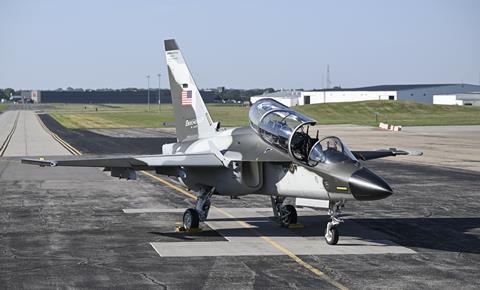
Weapons training complete, QB transitions to a demonstration of the M-346’s aerobatic abilities, including multiple barrel rolls, a full inverted loop accomplished with aerodynamic ease, and a level-flight sprint to Mach 0.88 (590kt), which triggers the blaring of maximum speed alarms.
The “clean” M-346 trainer version can go even faster, its more streamlined profile unencumbered by missile pylons and countermeasure dispensers. In a dive, the standard M-346 trainer can reach supersonic speeds of approximately M1.15 and withstand a 7.33g load.
Any violations of the jet’s approved flight envelope can be automatically controlled for by an Automated Recovery System, that will prevent student pilots from stressing the airframe beyond its specified tolerances for airspeed or g-force.
“Do you want to try 5g’s?” QB asks innocently over the intercom.
With such opportunities vanishingly rare for a humanities major, the go-ahead is returned through gritted teeth.
“Do you know the g warm-up technique?” his Italian accented voice casually inquires.
“Uh… no,” comes the answer, any attempt at proper radio decorum long since abandoned.
“Okay,” QB replies, before wrenching into a mind-altering upward left turn that notches 5g – an occurrence that can be recalled thanks only to the quick work of the g-suit automatically inflating to prevent blood from draining out of the brain.
The gut-wrenching manoeuvre completed, QB points the nose back toward Beech Field and descends into a perfect air force flare, wheels on tarmac for just a few seconds before accelerating into a touch-and-go.
The only feature of the M-346 that QB was unable to demonstrate, owing to airspace restrictions, is the Pilot Activated Altitude Recovery System (PARS). Triggered by a large red button on the cockpit centre console, PARS will automatically restore the jet to level flight at a safe altitude.
The safety feature can be initiated during loss of spatial orientation, which can occur for both new and experienced aviators, particularly while flying with night-vision goggles.
The US Air Force has installed a similar system in its Lockheed Martin F-16s, which has saved multiple lives, pilots have confirmed to FlightGlobal.
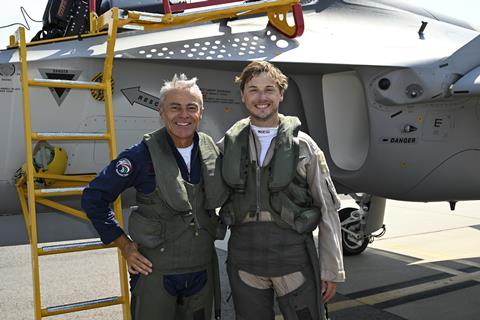
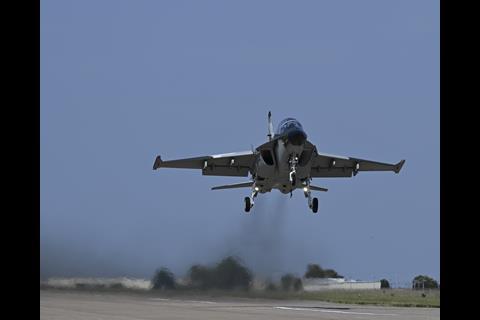
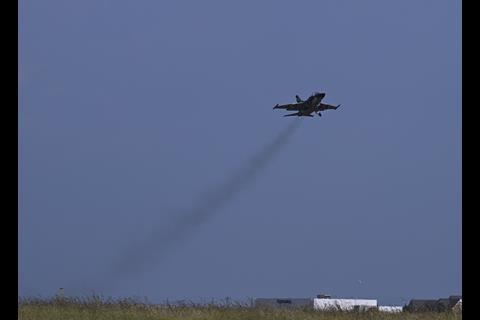
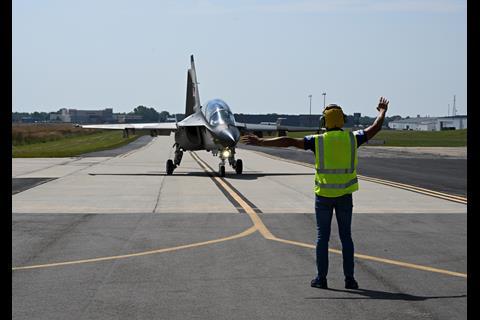
A short pass around the Textron manufacturing campus that surrounds Beech Field and the M-346N demonstrator touches down again, completing its first public flight in North America.
Textron hopes the new aircraft will become the USN’s future jet trainer, as the service prepares to replace the aged Boeing T-45 Goshawk under the UJTS programme.
Competition for the deal is heating up, with a formal request for proposals (RFP) expected in December and offerings from Lockheed Martin, Boeing and Sierra Nevada expected to vie against the new Beechcraft jet.
Textron already provides multiple training aircraft to the navy, including the Beechcraft T-6A turboprop, which is used by both the navy and US Air Force for primary flight instruction.
The navy also uses the Beechcraft T-44 – a derivative of the King Air 90 – for multi-engine certification. That type is in the process of being replaced by another Textron design – the Beechcraft T-54A, which is based on the newer King Air 260.
“We have a long, rich history producing training aircraft for the navy,” says Travis Tyler, senior vice-president of Textron Aviation Defense.
“Overall for the US military, we have over 85 years of experience,” he adds. “We think it makes sense, with our experience and our relationship with the navy, to move them right into a Beechcraft M-346N.”
With the new jet offering, Textron hopes to become to sole provider of fixed-wing trainers for the USN, covering each stage of certification before frontline aircraft.
Tyler says Textron deliberately sought out a partnership with Leonardo for the company’s UJTS bid, noting the 10-year proven record of the M-346 trainer in Europe, the Middle East and Asia.
“They have an aircraft that was specifically designed and engineered for the purposes of training aviators,” he notes. “They have a history of continuous improvement over those 10 years.
Leonardo has delivered 100 examples globally, which have collectively logged more than 150,000 flight hours.
The Italian airframer has also seen success with the USN, supplying the TH-73A light-single helicopter that is now the service’s primary rotary-wing trainer.
“Leonardo today has a tight relationship with the navy,” Tyler says.
Under the teaming agreement between Textron and Leonardo, the Italian airframer will act as a supplier of major structural components for the M-346N, while Textron will be the prime contractor handling final assembly.
Tyler says that Textron has not yet settled on a manufacturing site for the jet, but confirms it will be assembled in the USA.
The M-346N Beechcraft test demonstrator was first assembled in Italy, then disassembled and shipped to Wichita, where it was re-assembled and is now flying from Beech Factory airport – home to the original Beechcraft delivery centre.
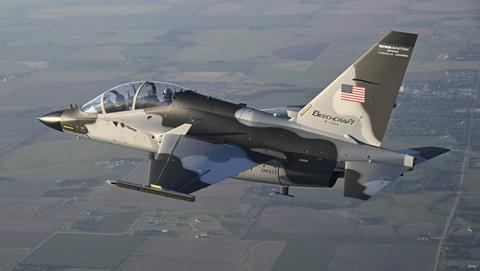
The exact design for the M-346N is still being finalised, since the navy has not yet issued its formal RFP. Tyler says Textron expects to submit its bid by the spring.
However, some aspects of the final configuration have already been set. Both Leonardo’s Block 20 M-346 and the navy-focused Beechcraft M-346N will keep the same wing and outer mold shape as the current M-346.
That includes the twin Honeywell F124 turbofans and Martin-Baker MK16 ejection seats.
Some specific features will be added for the USN, such as the Precision Landing Mode (PLM) used to reduce much of the stress and error associated with touching down on the pitching deck of an aircraft carrier.
The navy’s top aviation officer, Vice Admiral Daniel Cheever, described the PLM technology as “incredible” during a recent talk at the Center for Strategic and International Studies in Washington, DC.
Cheever recounted his experience landing a Boeing F/A-18E/F Super Hornet on the navy’s newest aircraft carrier, the USS Gerald R Ford, which is equipped with PLM.
“I clicked the button and it flew the best pass I’ve ever seen,” Cheever said. “Literally, the ball didn’t move, and I landed exactly where I wanted to land.
“Incredible capability,” he added.
Confidence in that technology led the navy to drop the requirement for its UJTS trainer to physically land on the carrier. Earlier this year the service went even further, eliminating the need for the new trainer to carry out field carrier landing practise on land.
Both Leonardo and Textron are eyeing expanded roles for the Block 20/M-346N jets, including providing a lower-cost option for adversary air training. The fighters will have an adjustable flight control system that can be calibrated to make the nimble jet respond like a larger, much heavier aircraft.
This feature could be used both to better represent the frontline aircraft that pilot trainees are preparing to fly, or to more accurately simulate the flight performance characteristics of the enemy jets those aviators could someday face.
Although being initially tailored for the USN, Textron also plans to make the Beechcraft M-346N available to overseas buyers.
“Our focus is going to be on the navy right now and meeting their needs,” Tyler says. “Once we get through that process, we will have opportunity to expand this particular version of the aircraft to allies across the world,” he adds.
Several major US allies, including the Royal Canadian Air Force and UK Royal Air Force (RAF), are expected to field new jet trainers in the 2030s.
Earlier this month, Leonardo suggested it would be open to locating an M-346 final assembly site in the UK, should London chose the Italian design as the replacement for the RAF’s BAE Systems Hawk T1 and T2s.
The USN currently plans to select a winner of the UJTS competition – and its new jet trainer – in 2027.
Arrayed against the Beechcraft M-346N are expected to be the Boeing T-7A, Lockheed Martin/Korea Aerospace Industries T-50, and Sierra Nevada Corporation’s newly revealed Freedom Trainer.
See more photos from FlightGlobal’s demo flight of the M-346N and watch cockpit footage from the hour-long sortie over Kansas: