












The first example of the US Navy’s (USN’s) new strategic airborne command post has rolled off the production line.
The navy plans to field the Northrop Grumman E-130J Phoenix II to replace the service’s current fleet of Boeing E-6B Mercury jets.
Those aircraft oversee the so-called Take Charge and Move Out (TACAMO) mission, connecting the US president and secretary of defense (recently renamed the secretary of war by the Trump Administration) with the navy’s fleet of nuclear-armed ballistic missile submarines.
Northrop secured the $3.5 billion TACAMO modernisation contract in 2024, with the new aircraft based on the Lockheed Martin C-130J transport.
Now, the airframe destined to become the inaugural E-130J has rolled off Lockheed’s C-130 production line in Marietta, Georgia.
“The new E-130J programme is right on track to meet [the] aggressive schedule,” the US Naval Air Systems Command said on 5 September. “The first airframe has emerged from the line to be converted into the first E-130J Phoenix II.”
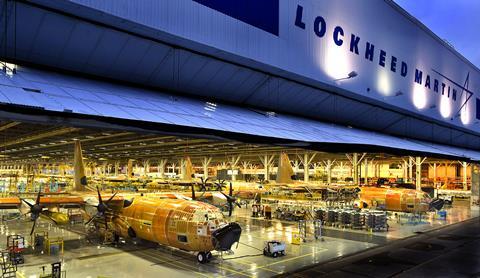
Workspace has been created at the Marietta production facility to handle conversions of standard C-130J airframes into the E-130J configuration, including the installation of sensitive communication equipment needed to connect with submarines deep below the ocean surface.
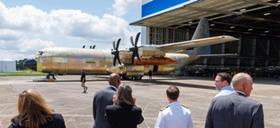
Delivery of the first Phoenix II aircraft is expected in 2026.
Although the navy’s TACAMO modernisation contract solicitation specifies a minimum buy of 8-12 aircraft, the service has not revealed how many E-130Js it plans to field.
The service currently operates 16 707-based E-6Bs for the TACAMO mission.
That fleet of 16 Mercury aircraft also serve as communications relay stations for the USN’s ballistic missile submarines, which operate clandestinely around the globe, including deep inside enemy waters.
Notably, while the E-6B currently handles both the TACAMO mission of controlling submarine-launched missiles and the separate responsibility for launching the US Air Force’s (USAF’s) ground-based intercontinental ballistic missiles, it appears the new E-130J may only be responsible for the naval weapons.
Although not yet confirmed, the USAF’s developmental Sierra Nevada E-4C Survivable Airborne Operations Center jet will likely take over responsibility for launching the ground-based missiles from the air – a mission known as “Looking Glass”.
Officially designated the Airborne Launch Control System, the Looking Glass serves as a fail-safe option in the event the subterranean launch control centres that oversee American nuclear missile silos “become incapacitated”, the USAF said in 2016.
The first E-4C example recently started flight testing.
Once operational, the navy’s E-130J will become the latest variant of Lockheed’s C-130, which the manufacturer says already comes in 17 speciality versions, including numerous military missions, a firefighting water bomber and a commercial freighter.