















Shield AI, the American start-up best known for its autonomy software, is progressing through testing of its new uncrewed tactical aircraft.
The company in October 2025 unveiled the autonomous jet, known as X-Bat. It will have Shield AI’s Hivemind artificial intelligence software, enabling it to operate without direct inputs from a pilot.
At the time of that announcement only conceptual videos and renderings of X-Bat were available.
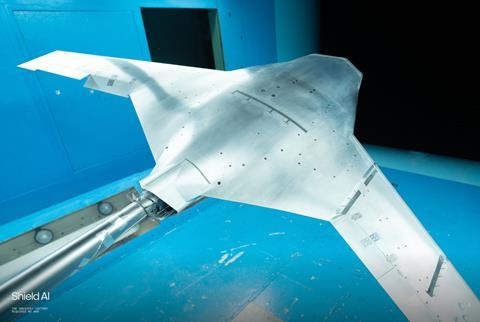
Three months later, Shield AI now says it has begun windtunnel testing the “cranked kite” design and released a photo of the subscale model being used for those aerodynamic flow evaluations.
“To move fast, you have to test fast. That’s why X-Bat is already undergoing windtunnel testing, reducing risk and sharpening each design iteration for greater safety and efficiency in the air,” Shield AI said in a LinkedIn post on 14 January.
At the time of the X-Bat reveal in October, Shield AI told FlightGlobal the new aircraft had been in development for the prior 18 months.
The company says the full-size X-Bat will have an 11.9m (39ft) wingspan, be 7.9m long and be powered by a single turbofan with thrust vectoring capability.
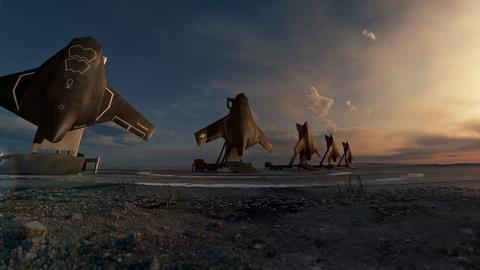
Notably, the X-Bat will feature a tail-sitting launch configuration for vertical take-off and landing (VTOL) using a mobile rail system.
A video depicts an X-Bat mounted to a wheeled launch trailer, with its wings folded. The wings unfold and the rail system orients the aircraft vertically. From there, it accelerates and takes off using only its internal engine.
Shield AI says VTOL demonstrations are planned for as soon as autumn 2026, with flight testing and operational validation following in 2028.
X-Bat will have more than 2,000nm (3,700km) of range and operate at altitudes of 50,000ft, it says.
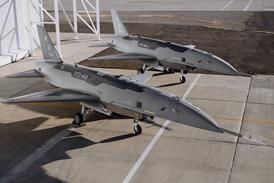
The Hivemind software that enables such autonomous operations powers numerous other uncrewed aerial systems (UAS), including the modified Lockheed Martin F-16D used by the US Defense Advanced Research Projects Agencyto conduct autonomous dogfighting experiments in 2024.
Those experiments saw Hivemind take control of the X-62A VISTA to engage in within-visual-range combat – better known as dogfighting or turn fighting – against a human pilot in another F-16.
Shield AI has also seen success with smaller UAS, such as the company’s tail-sitting V-Bat, which can launch and land vertically from shipboard flight decks.
The type is in use by both the US Navy and US Coast Guard.