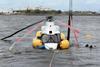
















Brazilian investigators probing the ditching of an Airbus Helicopters H160 have discovered that the rotorcraft was involved in a serious maintenance mishap a little over a week before the 2 January incident.
Initial findings from Brazil’s CENIPA accident investigation agency said the Omni Taxi Aereo-operated helicopter’s were pilots forced to ditch after encountering severe vibrations about 20min into their flight from Cabo Frio to an offshore platform.

Subsequent examination of the H160 (PR-OFB) showed the vibrations were caused by the fatigue fracture of a pitch-change rod on one of its five main rotor blades.
For identification purposes, Airbus Helicopters colour-codes each blade on the H160, with the broken part attached to the ‘white’ blade.
Updating its preliminary report on 5 February, CENIPA says CCTV footage taken from a hangar on 24 December shows a pitch-change rod coming into sustained contact with another part of the helicopter during a routine test of the main rotor swashplate bearing.
This required the removal of the right-hand main gearbox cowling before starting the procedure, as well as the protection and immobilisation of the pitch-change rods.
However, CENIPA says the CCTV shows that neither procedure was performed during the maintenance operation, although the left-hand cowling was removed.
“Images from the cameras also showed that, during maintenance services, one of the pitch-change rod assemblies became stuck on the [right-hand cowling] while the main rotor blades were being turned clockwise,” the report states.
Although this “disrupted” the rotation of the main rotor blades, the maintenance technician attempted to turn the rotor for another 6s until it “became unable to turn” due the “interference” between the two parts.
CENIPA says only by turning the main rotor anti-clockwise was the jammed pitch-change rod able to be freed.
Previous examination of the helicopter had revealed a permanent plastic deformation of 2.5° of the upper rod end bearing, with the fatigue failure initiation area “situated in the compressed side of the deformation”.
CENIPA says it has not been possible to determine from the CCTV footage whether the pitch-change rod involved in the maintenance event was attached to the ‘white’ blade, nor whether the incident caused the deformation of the component.
However, a subsequent review of images taken of the helicopter during its examination revealed touch-up paint and marks on the cowling, plus marks on the ‘white’ blade pitch horn “that were consistent with an interaction with the pitch-change rod”, CENIPA says.
Investigations into the incident, in which all eight occupants were rescued without injury, are continuing.