











Defence start-up Anduril Industries plans to develop a new uncrewed jet for a competitive US Navy (USN) programme, rather than adapt its existing Fury design.
Anduril was among several US manufacturers selected by the navy this month to develop concepts for a carrier-capable Collaborative Combat Aircraft (CCA).
The semi-autonomous tactical jets are envisioned as supporting conventional fighters with additional weapons and battlefield effects.
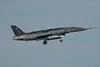
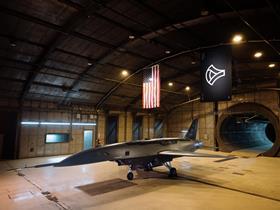
The US Air Force is separately running its own CCA development programme, which has already progressed to the flight testing phase. Anduril and its YFQ-44A prototype are finalists for the first increment of the air force CCA contracts. The YFQ-44A is a derivative of Anduril’s autonomous Fury jet.
As the company prepares to begin flight testing the YFQ-44A next month, Anduril executives say they plan to design an entirely new aircraft for the navy CCA programme.
“If we were to build a navy CCA, it would probably look nothing like a Fury,” Jason Levin, Anduril senior vice-president of engineering for air dominance and strike, said on 22 September at the annual Air & Space Forces Association conference outside Washington, DC.
The Fury was designed to operate conventionally from land-based runways.
By contrast, aircraft flying from USN ships generally need specific features like larger, folding wings to support shorter take-off distances and limited onboard storage space. Naval jets also need reinforced airframes and landing gears capable of handling forces associated with tail-hook recoveries.
Even multi-variant aircraft like Lockheed Martin’s F-35 stealth fighter have significant design differences between conventional and carrier-capable versions. That reality likely makes adapting the Fury for naval operations less practical than designing a separate CCA specifically for supporting carrier air wings.
“The way we would approach other air vehicle development efforts is, they would not be Fury derivatives,” Levin specifies. Such would be the case, he adds, for any future CCA intended to perform missions different from those specific to the Fury.
That jet is primarily oriented toward the defensive counter-air mission, with a focus on supporting conventional fighters in air-to-air combat.
Though the outer-mold shape of a subsequent Anduril CCA will be different, Levin says that aircraft will likely have many internal systems and technologies pioneered for Fury, such as avionics hardware, autonomous flight control software and design and fabrication processes.
Anduril is using its own internally-developed software to control flight operations for the Fury/YFQ-44A.
Levin says a third-party vendor will separately provide the mission autonomy software, which will enable a CCA to integrate with crewed fighters, receive orders and carry out directives.